

AI fake news is now an ‘existential risk’ for companies
Generative AI technology has fundamentally changed the form of reputational risk that companies face.
In particular, due to the development of voice and video synthesis technology, it is no longer unfamiliar for non-existent statements or actions to be consumed as if they actually happened.
Now, the ‘fake but real content’ that is spreading in the online space goes beyond simple controversy and can threaten a company’s social trust, customer relationships, and brand image.Direct and structural reputational riskIt is becoming.
“Is this statement true?” Company representative AI fake news that started with YouTube Shorts
“Is this statement true?” AI fake news from corporate representatives that started with YouTube Shorts
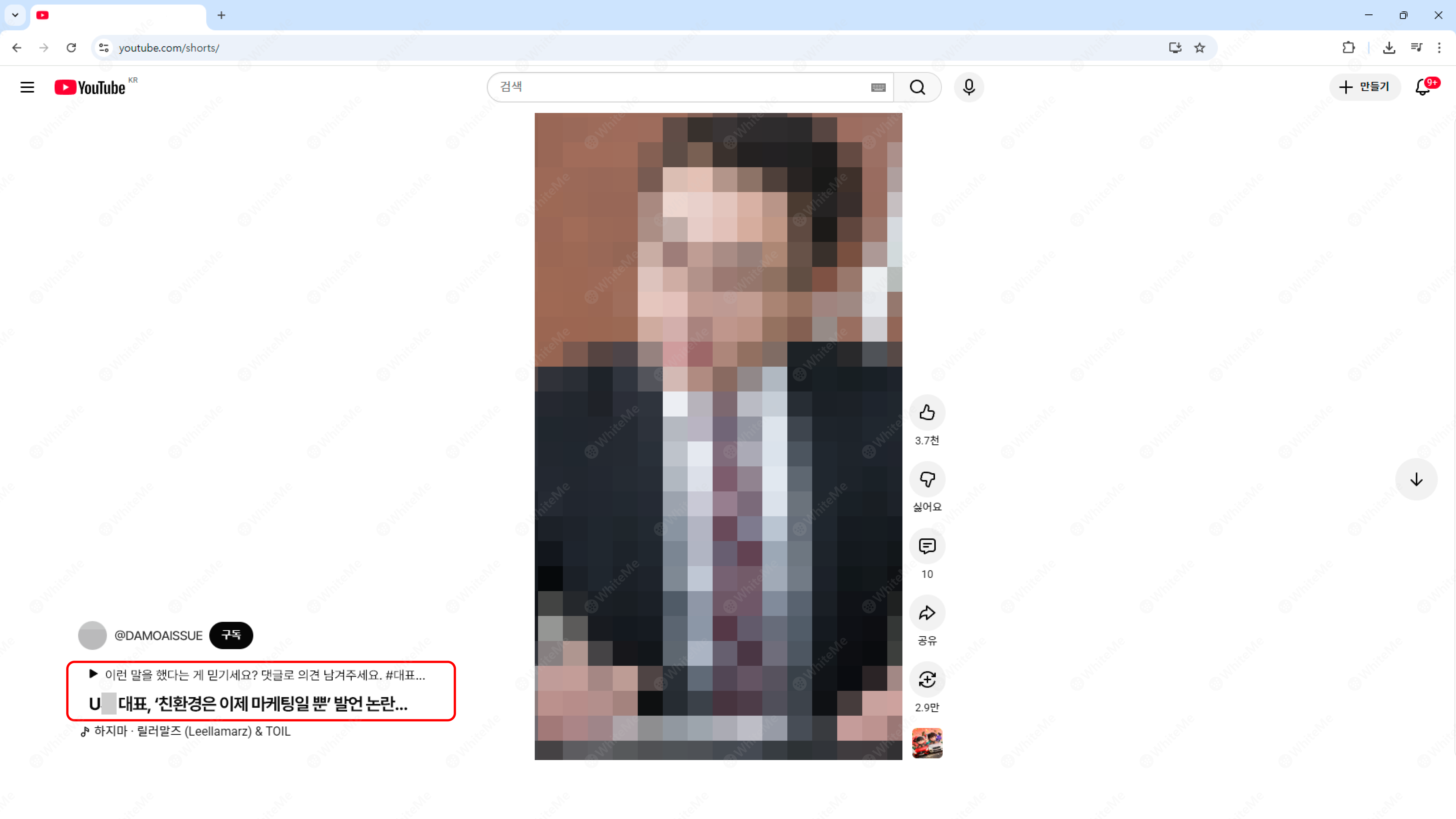
Earlier this year,Company U, a large household goods brandbecame the center of social controversy without warning.
On a YouTube shorts account“CEO of Company U, controversy over inappropriate remarks regarding social conflict issues”The incident started when a 15-second video titled was uploaded.
The voice in question was a ‘fake speech’ synthesized by AI, but most viewers did not suspect this at all at first. The reason was the sophistication of the voice.
Why didn't anyone notice it was fake?
The synthesized voice did not simply imitate a ‘similar voice’.
AI learns the voices in CEO A's past interviews, event remarks, and promotional videos toContent that replicates the actual tone of voice, speaking speed, intonation on certain words, habit of ending sentences, and length and pause of breathing.It was.
As a result, there was no sense of discomfort at all, to the extent that even employees initially reacted by saying, “Isn’t this a real statement?” It was even more difficult for external viewers to judge the truth.
The controversy started with shorts and spread to all platforms.
- Views skyrocket within hours of upload
- Quickly re-upload to TikTok and Twitter
- More than 20 reprocessed short-form contents appeared
- Secondary spread with reactions from the community asking “Is this true?”
- Search auto-completion‘Abusive language’ ‘Hate speech’exposure
- Some YouTubers and SNS influencers recycle controversial content without verifying the facts.
- From partners, distributors, and customersRequest for official entryincrease
- There is confusion even internally about the authenticity.
At this point, Company U believes that this incident is not just an online rumor.An external crisis that tests the values and ethics of the entire companyI came to feel this fact.
📌 AI fake news, why it is difficult for companies to respond on their own
Why it is difficult for companies to respond to AI fake news on their own
Company U made various attempts to resolve this incident on its own, but it soon became clear that AI-based fake news is an area that is difficult to control using existing rumor response methods.
Especially when synthetic speech is included, the complexity of the response becomes incomparably higher than that of regular disinformation.
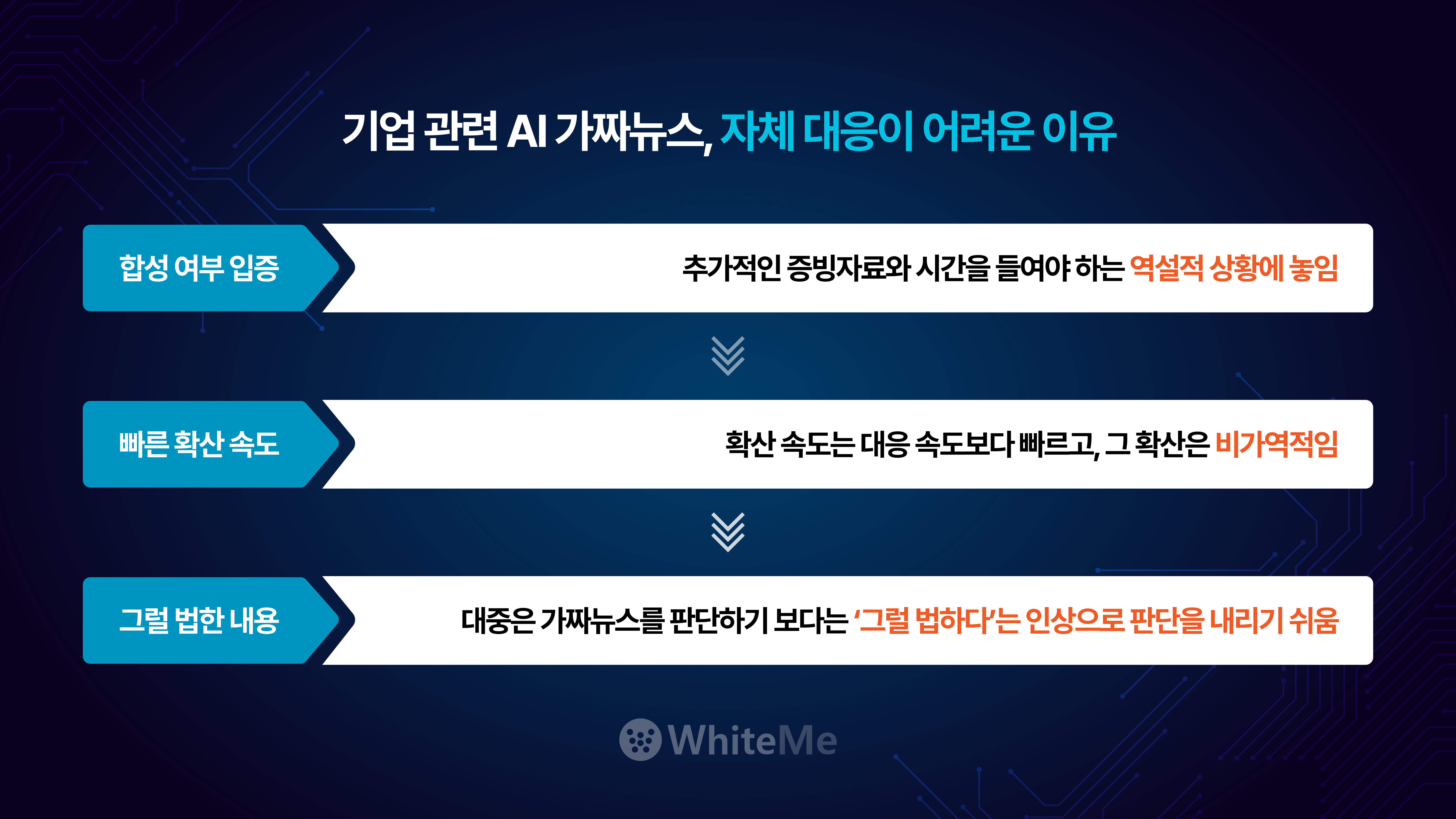
1. The platform requires ‘proof of synthesis’
The first problem Company U faced was that the platform did not simply process deletion requests.
The voice is AI synthesized.the obvious factDespite this, some platforms first asked the company for “technical evidence to prove that this voice is synthetic.”
As a result, companies are trying to take damage measures.A paradoxical situation that requires additional documentary evidence and timeIt was placed in
In the early stages of the spread, the most important rapid blocking cannot be achieved, and in the meantime, variants and copies increase simultaneously.The scale of damage grew noticeably.
In other words, due to the structural limitations of the platform, the affected company effectively lost the most critical ‘initial response time’.
2. The rate of diffusion is faster than the response, and its nature is irreversible
This case showed a typical short-form-based diffusion structure of ‘YouTube Shorts → TikTok → Twitter → Community’.
This structure can be achieved in a short period of timeDozens of derivative contentappears, turning public opinion into a fait accompli much faster than the company's deletion attempt.
Even if you delete the original, a version with subtitles, a responsive video, and a summary short form are already created and spread as new posts from other accounts.Once spread has begun, it is irreversible and difficult to reverse.has.
This results in public opinion moving much faster than the victim company can develop a response strategy or legal and PR interpretation, maximizing the difficulty of initial response.
3. Fake news moves public opinion based on ‘plausibility’ rather than truth.
In the case of this incident, which combines socially sensitive issues, the public is more concerned about “is this true or not?”The impression that “that is likely”We were in an environment where it was easy to make judgments based on just that.
In particular, because the AI-replicated CEO's speaking style, intonation, and breathing pattern were almost identical to his actual remarks, the public had already begun to accept the message in the video as if it were the 'representative's actual speech' even before questioning its truth.
At this point, fake news goes beyond simple information distortion.It serves as a standard for evaluating a company's identity, values, and ethics., the scope of damage extends beyond the technical level to ‘damage to social reputation.’
The biggest risk of AI-based fake news is not simply the technical problem of ‘difficult deletion’.
The more fundamental problem is that while content spreads, the time available for companies to respond is rapidly decreasing, and that short gap is“Dangerous times when companies seem to be silent.”It is interpreted as .
As this gap grows, the public begins to evaluate companies based on impressions already created rather than checking the facts, and AI synthetic content has the result of shaking the trust of the entire company regardless of whether it is true or not.
White Me’s AI-based deletion and blocking process
White Me’s AI-based deletion and blocking process
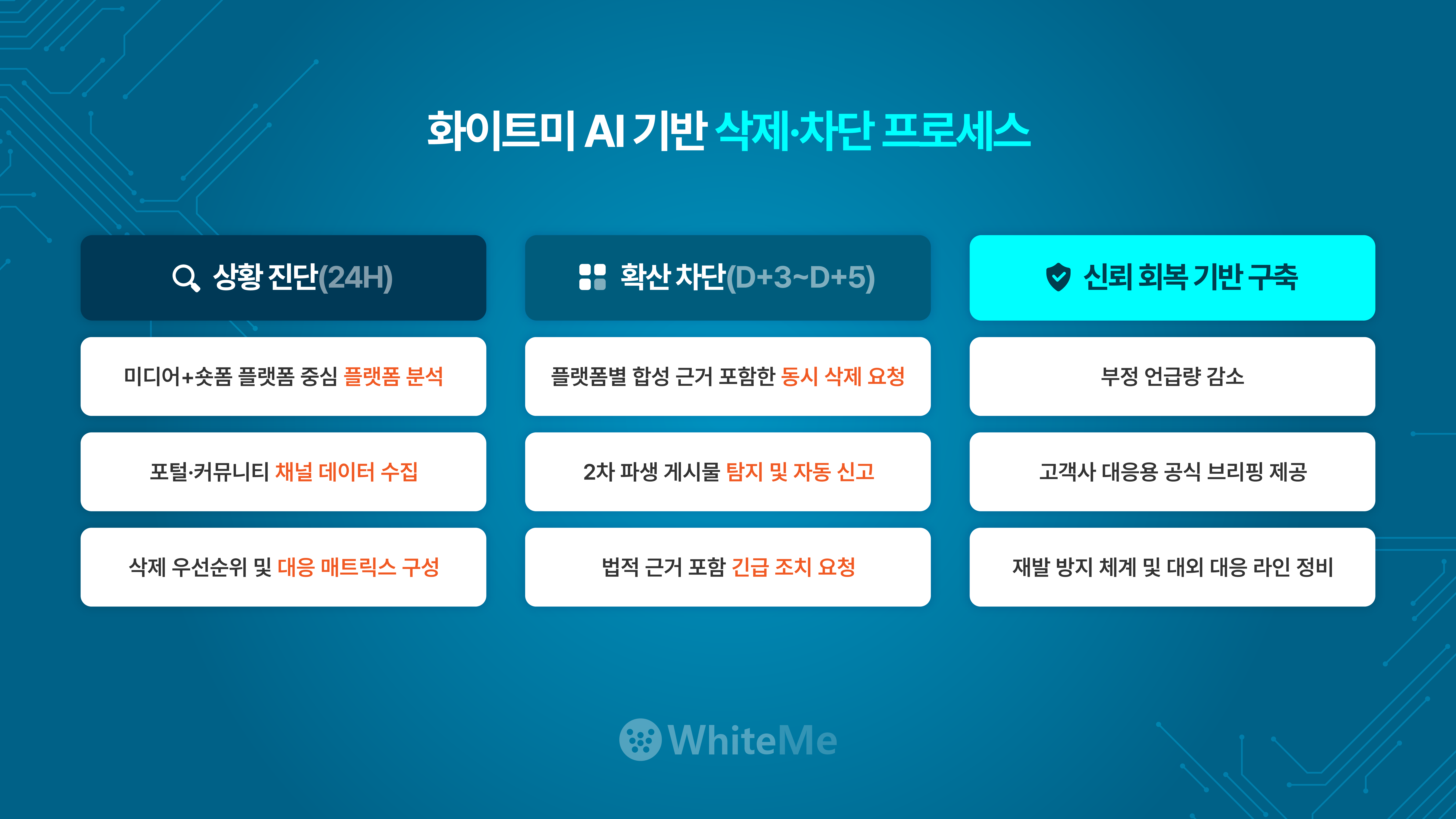
As soon as White Me receives the case,AI-synthesized content-specific response processhas been activated.
1) Diagnosis of situation (within 24 hours)
- Analysis of short-form focused platforms such as YouTube, TikTok, and Twitter
- Data collection from more than 20 channels including portals and communities
- Configuring deletion priority and response matrix
2) Block the spread (D+3~D+5)
- Simultaneous deletion request including grounds for synthesis by platform
- Automatically detects mirroring and duplicate content and blocks further spread
- Request urgent action with legal basis from overseas platforms
3) Building a foundation for trust recovery (3 weeks)
- Negative mentions reduced by more than 80%
- Providing official briefings for customer response
- Establishment of recurrence prevention system and external response line
White Me’s automated detection and deletion systemDeleted and blocked redistribution of more than 90% of all content within 72 hoursI created a result that did.
How did corporate AI recover from the damage caused by fake news?
characteristic
Before intervention
After intervention
result
Response start time
3 day delay
Within 2 hours
36 times shorter
amount of negative mentions
upsurge
80% reduction over 3 weeks
stabilizing public opinion
Inquiries from partners and customers
Runaway
stabilization within a week
Restoration of external trust
Internal member confusion
increase
Calm down after formal briefing
restore internal trust
After the White Me intervention, Company U experienced the following quantitative and qualitative recovery. The CEO of Company U said the following after this incident:
“It was not enough to correct that it was an AI composite. This responseAn opportunity to renew the digital trust system of the entire company“It has been done.”
📌 Preemptive response to recurring digital controversies is the answer.
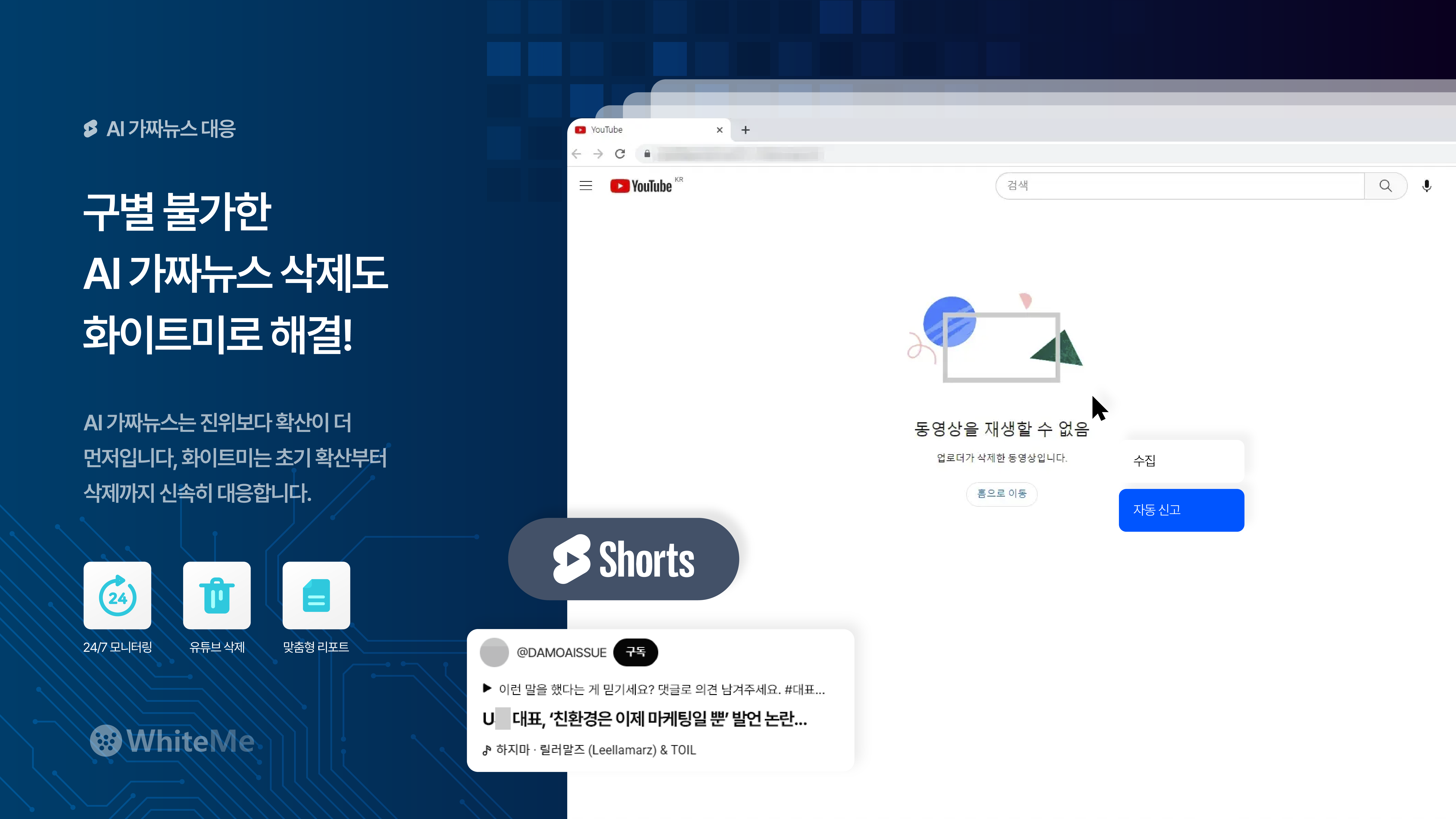
Preemptive response to recurring online rumors is the answer.
AI-based fake news is not a one-time problem that appears and ends once, but persistently targets specific companies or people.A structural threat that can be repeatedly reproduced by changing its form.no see.
Especially now that synthetic voice and video technology has become popular, it has become possible for anyone to create ‘likely remarks’ by learning the audio of past interviews of company representatives in a matter of minutes.
For this reason, online rumors can no longer be resolved with just one sentence, “It’s not true.” Failure to respond in a timely manner risks distorting a company’s value judgment or solidifying incorrect perceptions.
Immediate consultation is required in the following situations:
- If short-form based AI fake news such as YouTube shorts or TikTok is spreading,
- If synthetic audio or video targeting CEOs or executives is being distributed,
- If platform-level action is delayed
- If public opinion is worsening due to social controversy
- If you are in a situation where you need a ‘trust recovery strategy’ rather than just simple deletion,
Although crises are difficult to predict,A prepared company does not waver.
In an environment where online rumors are constantly emerging, White Me is with the entire process based on technology and a structured response process to help companies protect their own trust.

Are your company's reputation and trust being shaken by AI fake news, deepfakes, and distorted posts? Try the White Me service right now.[Service inquiry]