

.jpg)
As consumer response becomes more active, brands face ‘new concerns’
When brand response begins to grow rapidly after entering Japan, new concerns come along with joy. When it becomes a hot topic on social media, leads to actual visits, and the experience starts to accumulate again on review platforms such as Tabelog, the moment comes when you think, “Now there is a response from the local community.”
But actuallyCustomer data (VOC) such as reviews and postsis increasing, but it is often more difficult than you think how to keep up with the reactions and what to read first.
Especially for small and medium-sized restaurant franchises with few employees, their hands are already full just with store operations and local adaptation. Here, Japanese local platforms such as TabelogIf you have to manually take care of reviews, the operational burden is bound to increase quickly.
Company J, the client in this case, was in a similar situation. After entering Japan, brand awareness quickly increased through social media, and Tabelog reviews naturally began to increase along with visitors.
However, as it was in the early stages of the business, the internal structure to constantly monitor the response was not yet in place.I felt that the number of reviews was increasing, but it was difficult to structurally figure out which responses were being repeated and what to look at first.
📌 Case Preview
- Problems small organizations face when entering overseas markets
- Repeated signals were difficult to read simply by checking reviews.
- Among many monitoring companies, ‘Why did you choose White Me?’
- Customer VOC drives operational improvement
- Japan’s No. 1 review platform ‘Tabelog’, monitor customer reviews with White Maze!
- Contact us for service
Problems small organizations face when entering overseas markets

Problems small organizations face when entering overseas markets
Company J is a small and medium-sized restaurant franchise company that has achieved rapid growth in a short period of time starting in the Korean market and has recently succeeded in pioneering the Japanese market. They say they are busy developing the Japanese market in one way or another as they begin to receive responses from Japanese customers.
As mentioned above, it is said that after receiving an explosive response in a short period of time in Japan, Company J had difficulty in pioneering the market.
First, I heard directly from Director Ha Jun, who is in charge of company J's business operations, about the situation at the time.
Hello, Director. First, could you introduce yourself and briefly tell us what company J was doing in the Japanese market at the time?
Hajun: Hello, I am in charge of overseas business operations at Company J. After entering Japan, I was looking at local operations and customer reactions, and since I was using both Korean and Japanese for work, I think I approached my work with the mindset of 'I can just check the reviews.'
However, when the market grew and the time came to look at more customer data, it was not realistically easy for me to constantly check local reviews, including Tabelog, and read the nuances of the large amount of data alone, as we were a small organization with less than 10 employees.
The reason Company J was experiencing difficulties was not simply because the number of reviews increased. After entering Japan, as the brand response grew through SNS, the number of visitors and online reviews increased, and the task of checking the response in a timely manner felt increasingly burdensome.
In particular, if customer VOC (reviews) are scattered across multiple channels, including Tabelog, it is not easy to check the data and even figure out what reactions are being repeated.
As Director Ha Jun said, in small organizations without dedicated personnel, it was easy for this verification work to be pushed back or omitted depending on the individual person in charge's schedule, and it was at that point that Company J also felt the need for systematic monitoring.
Moreover, one of the obstacles preventing operational improvement was the lack of an internal process that could meaningfully interpret customer data while consistently keeping up with the growing response.
In the early days of entering Japan, there is a lot to take care of just brand exposure and store operation, so even though you know that review monitoring is important, it is easy to keep getting pushed back.
Then, the situation continues: “Customer response is increasing, but it is not clear what kind of response was actually received.”Interpreting reviews individually and structurally reading repeated dissatisfaction and satisfaction points in responses accumulated on multiple platforms are two different areas of ability.Because this is it.
In the end, what Company J needed wasIt is not simply a system where you can 'check many reviews', but a system where you can check local Japanese VOCs, including Tabelog, on a daily basis and derive insights from that data.It was.
Repeated signals were difficult to read with simple review checks.

Repeated signals were difficult to read with simple review checks.
So, even though Company J said they were checking reviews before, why did they have to miss out on important trends?
This question is actually a concern that many brands face at least once. The worry is, “I’m looking at the data, but why isn’t there anything left?”
It's not that he didn't read the reviews at all, but he said he actually felt like he was missing an important point. Please explain what specific internal method was followed to check customer response at the time and why it was difficult to improve operations using that method.
Hajun: Like any other company, we went to the platform and manually checked brand-related reviews when we had time, but it wasn't a method that could be continued consistently, and it was difficult to catch which stories were being repeated overall.
For example, at first I thought that the response to the spiciness of food sold at the Japanese branch was just a difference in taste among some customers, but later, based on the data, I found that it appeared quite repeatedly in negative reviews. Until then, I was only looking at scattered reviews individually, so I didn't realize that much.
What is important here is not ‘Did you read the review or not?’ The more important issue is ‘How did you read the review?’
Manually collecting customer reviews may be helpful in simply checking customer reactions, but it has clear limitations in deriving insights by interpreting multiple reviews as a single flow.
This is because it is difficult to structurally check which channel, at what point, and which expression is repeated.no see.
What particularly impressed me in the case of Company J was the customer reaction to ‘spicyness.’Internally, we thought this was due to differences in taste among some customers, but when we analyzed it based on actual data, we found that more than half of the negative reviews were related to spiciness.
There is a big difference between simply checking data and deriving insights that can improve operations.This is because the impression felt in the field and the actual pattern of accumulated customer responses may differ.
Ultimately, the areas that White Me wants to provide to customers through automatic monitoring and VOC analysis are:Helps reduce the hassle of VOC management and improve operations as efficiently as possibleIt is in
He said that it was at that point that Company J also recognized the need for automatic collection and monitoring. Seeing customer reactions and receiving those reactions as interpretable data were clearly two different levels.
Among many monitoring companies, why did you choose ‘White Me’?
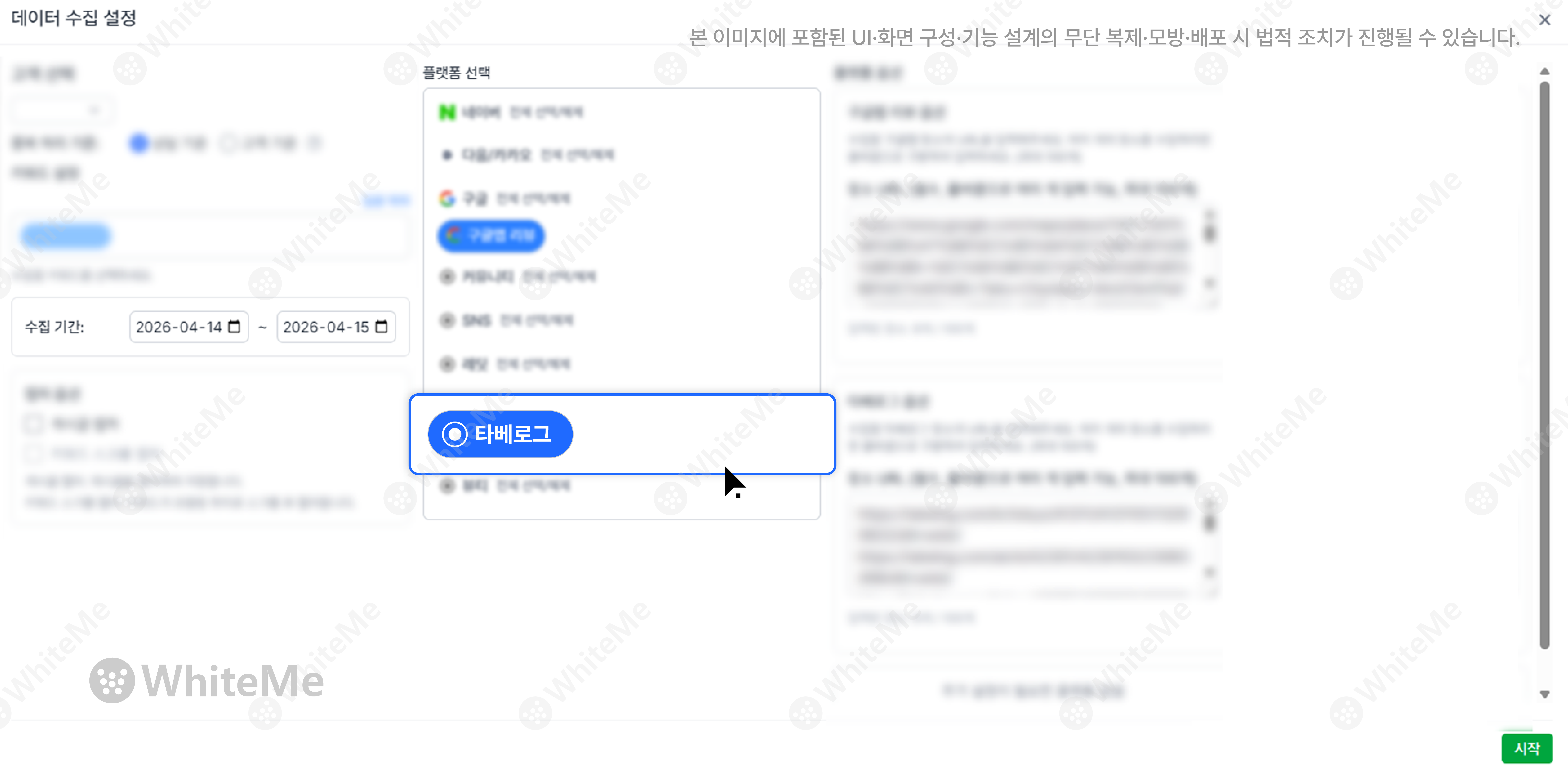
Among many monitoring companies, ‘Why did you choose White Me?’
Hajun says that although the need was clear, it was not something that could be decided right away.
Not only were there a small number of domestic monitoring companies that also monitored Japanese platforms, but it was not realistically easy to require a specific platform called Tabelog and the specificity of automatic monitoring.
So this time, we asked what limitations Company J felt while reviewing various companies and what was the decisive factor that led them to choose White Me.
Although the need to check local VOCs in Japan was clear, I heard that it was not easy to actually find a way to monitor them, including Tabelog. What difficulties did you encounter in the process of reviewing various companies, and why did you ultimately choose White Me?
Hajun: At first, we looked into marketing and PR companies as a service to see Japanese reactions. However, when we talked about it, it was common for people to say that Tabelog was difficult, or that the scope of Japanese local reviews was limited.
From our perspective, it was meaningful to be able to see the channel where actual responses were accumulated, so that was the most disappointing part. Then, I inquired after seeing White Me's Japanese VOC case, and I think the fact that it was possible to provide services after custom building if you tell me about lesser-known platforms, including Tabelog, played a big role in my decision.
He said that the reason Company J chose White Me was not simply because they were looking for a new solution.
What was more important was that I wanted to create a system based on a platform where actual customer responses were accumulated in Japan.
What companies operating in the local market need is a realistic answer to the question, “Can we actually check the responses we are missing right now, rather than a flashy description of functions?”It was close to .
White Me replaces Company J’s existing manual monitoring method.We have organized the direction so that we can switch to ‘automatic collection-based’.
- Provide local review monitoring service in Japan including Tabelog
- Switch from manual verification to automatic collection-based
- Establishment of an integrated monitoring system for scattered customer responses
- Providing insight reports and establishing an operational foundation to confirm repetitive review patterns
The focus was to continuously collect Japanese local VOC, including Tabelog reviews, in real time and create an environment where scattered responses could be viewed as a single flow.
Beyond simply making monitoring easier,Re-establishing a process that does not miss responseIt was.
In fact, in small and medium-sized businesses in the early stages of business, there is quite a big difference between ‘an organization that searches for responses’ and ‘an organization that has a structure that automatically collects responses’.
In the former case, monitoring can easily be interrupted depending on the schedule of the person in charge, while in the latter case, there is at least a basis for checking without missing anything.
This was exactly the change that Company J wanted. Rather than collecting more reviews,What was needed was a practice-oriented foundation that could confirm important responses in a timely manner and lead to actual operational improvement data.
Customer VOC drives operational improvement

Customer VOC drives operational improvement
So what has actually changed? After establishing automatic collection-based Tabelog review monitoring, Company J was able to focus on ‘reading reviews accurately’ rather than ‘reading them a lot.’ And that change led to more specific operational decisions than expected.
After introducing White Me’s automatic monitoring service, what did you feel was the biggest difference compared to before?
Hajun: The biggest change was that we were able to see customer reactions much more reliably. In the past, even if there were a lot of reviews, it was only a case of being impressed for a while, but in the future, we started to see more clearly what reactions were repeated.
And with this data, it seems that it has become faster to find key points that need to be improved during actual operation.
The biggest change that Company J experienced was that it was able to move away from the vague state of “there are a lot of reviews” and see “what responses are actually being repeated.” Previously, it was closer to reading reviews individually, but now we have a basis for more reliably checking and interpreting local customer reactions in Japan.
The change was also evident in product judgments. Before the introduction of the monitoring service, Company J accepted negative reviews regarding spiciness as the result of differences in taste among some customers.
However, looking at the data collected based on automatic collection, the keyword appeared repeatedly in negative reviews and its proportion was not small.Only then did the internal standards change. The standard for whether to view a problem as an exception or an operating point that requires adjustment has changed.
Afterwards, Company J adjusted the spiciness of the product and was able to receive a more positive response. What's important here is not just that the menu has been adjusted.
Without systematic collection of customer responses, this decision would likely have been made much later or not at all.The starting point of change was being able to accurately identify the problem rather than responding to it itself.It's closer to look at it.
As a result, Company J was able to read changes in customer experience through local reviews, including Tabelog, and have a structure to connect them to operational decisions.
This means that we have moved on from a stage of vague perception and have moved one step further to becoming an organization that can pinpoint the cause of change and organize a response.
Japan’s No. 1 review platform ‘Tabelog’, monitor customer reviews with White Maze!
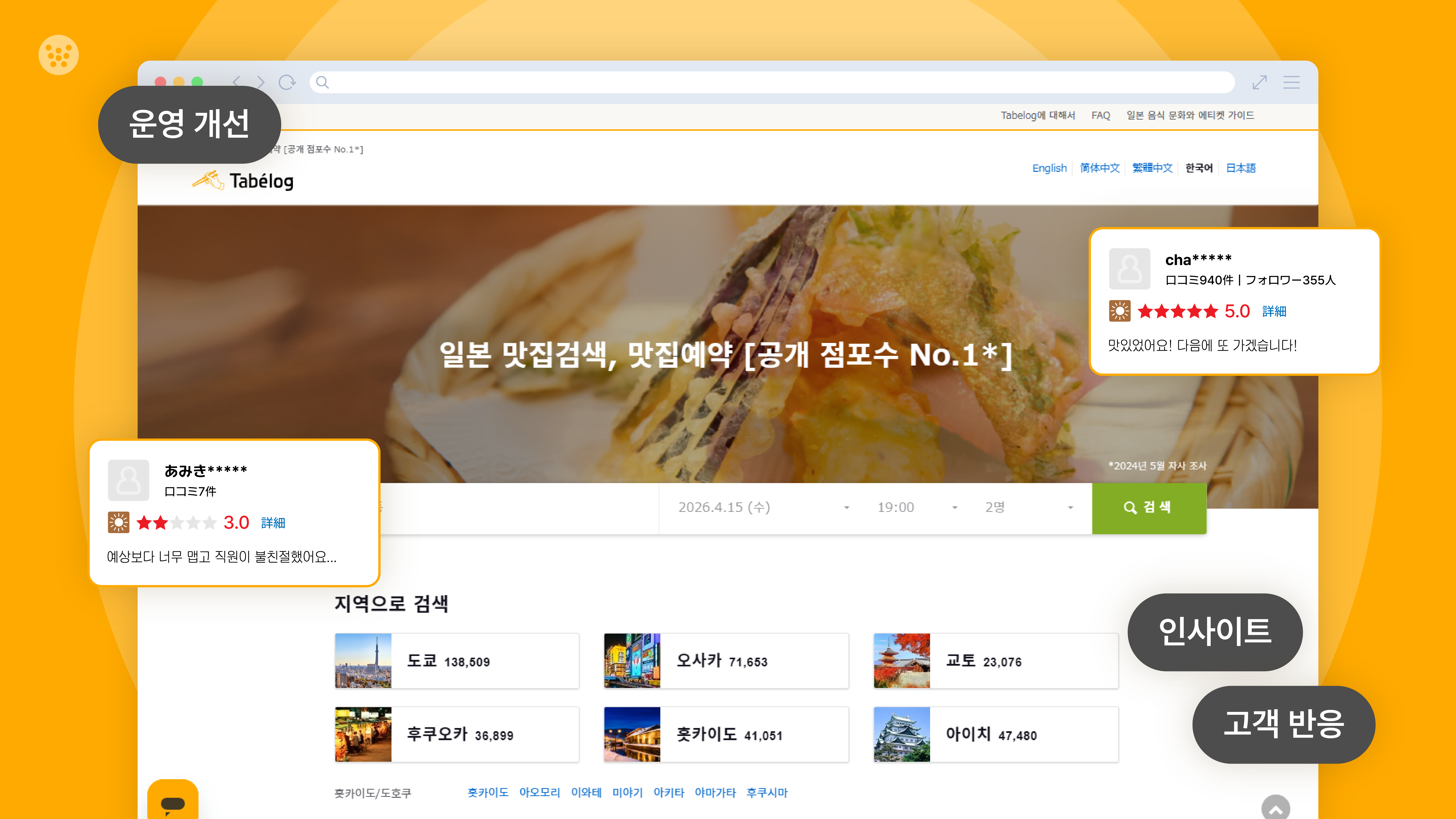
Japan’s No. 1 review platform ‘Tabelog’, monitor customer reviews with White Maze!
There is one more thing to point out here. This is a story about why monitoring Tabelog reviews is important.
The reason why monitoring local reviews in Japan is particularly difficult is not simply because of the large number of reviews. This is because the characteristics and operating environment of each platform are slightly different from Korea, and the differences lead to practical burden.
There are clear limitations for a small organization like Company J to follow all of these responses manually.
If this situation repeats, an inspection is necessary at least once.
- Verification of local reviews depends on the personal work of the person in charge
- Difficult to structurally view repeated customer responses
- There is a burden in interpreting the detailed nuances of Japanese reviews.
- Monitoring is lost due to operational priorities
- Customer reviews do not lead to menu and operation improvements
Tabelog is Japan's leading restaurant review and reservation platform with approximately 100 million monthly users, information on over 890,000 restaurants nationwide, and over 85 million actual reviews.no see.
As it is considered the most trusted service by Japanese locals when searching for good restaurants, it can be seen as a channel through which realistic customer experiences and responses are directly accumulated from the perspective of restaurant franchise companies pioneering the Japanese market.
White Me can become a key point for brands entering the Japanese market.Supports monitoring of Tabelog reviews based on automatic collection.
Our monitoring service does not end with simply collecting data,We focus on creating a structure so that we do not miss the signals needed for actual operations.
If you are a brand that wanted to read Japanese local reactions more reliably, this point can be especially helpful.

If you have been feeling pressured by the rapid increase in local reviews and posts in Japan, this case may not be too unfamiliar. If you have been wondering how to view the reactions of major Japanese platforms, including Tabelog, without missing a beat, feel free to consult with White Me on the direction of Japanese VOC monitoring that suits your current operation method.
📚Check the service introduction
✉️Email inquiry:support@whitemekorea.net
※ This case image was created with AI to protect customers. White Me protects customer information in accordance with NDA.