

How is the brand perceived after rebranding?
Rebranding is ‘redefining a brand.’ It is also a process of reorganizing what direction the company will take and what language it will use to communicate with the market.
However, after rebranding, it is a completely different task to check how the brand is perceived in the actual market.
There is often a gap between apparent changes and actual perceptions.
Z Construction Company, the company that visited White Me, recently completely reorganized its brand identity and message system (slogan) through company-wide rebranding.
We organized the brand tone and clearly established the direction of external communication. Looking at the rebranding project itself, it seemed to be being completed stably according to plan.
However, after branding, there was one question that did not easily go away within the brand strategy team.
“Is our brand now really being read with one voice?”
The way each department, including design, construction, and sales, interprets the brand is slightly different, and the evaluation criteria for viewing the brand online are also no longer unified.
Keywords and perceptions formed based on past issues were also scattered throughout communities and social media, making it difficult to determine whether the changes after rebranding were actually leading to a restoration of trust.
At this point, Z Construction Company felt the need to manage brand awareness surveys, voice of customers (VOC), and online public opinion as a single flow rather than dispersed indicators.
📌 Case Preview
- The need to check brand perception after rebranding
- Distributed brand message structure by department
- Transitional period of perception after rebranding vs. difficulty in determining reputation risk
- Why we started looking at brand awareness, VOC, and online public opinion together
- VOC analysis approach that provides ‘judgment standards’ rather than correct answers
- Continuous public opinion management required even after rebranding
- Checking brand awareness and public opinion after rebranding
- VOC & online public opinion must be analyzed together to reveal the structure of perception
The need to check brand perception after rebranding

The need to check brand perception after rebranding
I heard that even after completing the rebranding, it was difficult to be confident that the brand was being read with one voice. What was your biggest concern at the time?
Dohyun: I thought the rebranding itself was completed well. The message was organized, and we all agreed internally on the overall direction. But strangely, it didn’t seem like our brand was being read as one from the outside.
The situation that Z Construction Company faced after rebranding was a common problem faced by many companies.
Although it felt like the brand direction had been organized internally, the changes were not interpreted in the same way externally. What is particularly noteworthy is that there were limits to recognizing this situation as a clear ‘brand reputation risk’.
There was no issue that needed immediate response, nor was there any fatal negative news for the brand.
Nevertheless, the uneasy feeling of “I don’t know if the brand message is being read properly” still remained, and Z Construction Company took this uncertainty itself as an important signal.
Company Z’s situation clearly shows that the first thing to check after rebranding is not ‘what we are saying,’ but ‘how the brand message is actually being read.’
Distributed brand message structure by department
How did you begin to feel internally that brand perceptions were mixed?
Dohyun: I couldn’t say which department was wrong. It was all true, but the problem was that the words didn't come together on the outside.
Each of Z Construction Company’s internal messages was sufficiently persuasive.
The design department focused on technology and expertise, the construction department focused on stability and reliability, and the sales department focused on performance and growth.
The problem is that these messages are not connected in a single context to the public in the online environment.
In communities and SNS, the standards for evaluating brands were different, and in some spaces, technology-centered evaluations were repeated, and in other spaces, interpretations based on past issues were repeated.
Looking at Company Z's situation, we can see that brand trust depends more on 'how it is already perceived' rather than 'what it says.'
Transitional period of perception after rebranding vs. difficulty in determining reputation risk
It must have been difficult to determine whether this situation was actually a problem that needed management or a transition period after rebranding.
Do-hyeon: I felt uncomfortable saying there was no problem, and there was insufficient evidence to say that we had to respond right away, so I think I inquired with the mindset of ‘let’s check the public’s reaction.’
Although negative issues were not rapidly spreading, keywords and perceptions based on past specific issues were quietly being repeated online.
This trend was not noticeable in the short term, but over time, it served as a part of solidifying the brand image.
The biggest problem at this stage is that it is difficult to realize whether ‘this situation requires management’ and what criteria should be used.
Z Construction Company has come to recognize that there are clear limitations in making decisions based solely on feeling or experience, and has clearly felt the need for a standard that can explain the brand status.
Why we started looking at brand awareness, VOC, and online public opinion together

Why we started looking at brand awareness, VOC, and online public opinion together
Was there a reason you decided to look at brand awareness, VOC, and online public opinion together?
Dohyun: We are talking about the same brand, but we are looking at different data. So, even though we had meetings, we couldn't come to a conclusion and had no choice but to repeat the same problems.
Inside Z Construction Company, the PR team, CS team, and brand team were each judging the brand based on different data. Each piece of data had meaning, but it didn't connect to a single picture.
As a result, there were different interpretations of the same brand internally, making it difficult to explain the current status of the brand using a single standard.
Amid these problems, you felt the need for data that could look at Company Z's brand awareness, VOC, and online public opinion from the same angle rather than using different indicators.
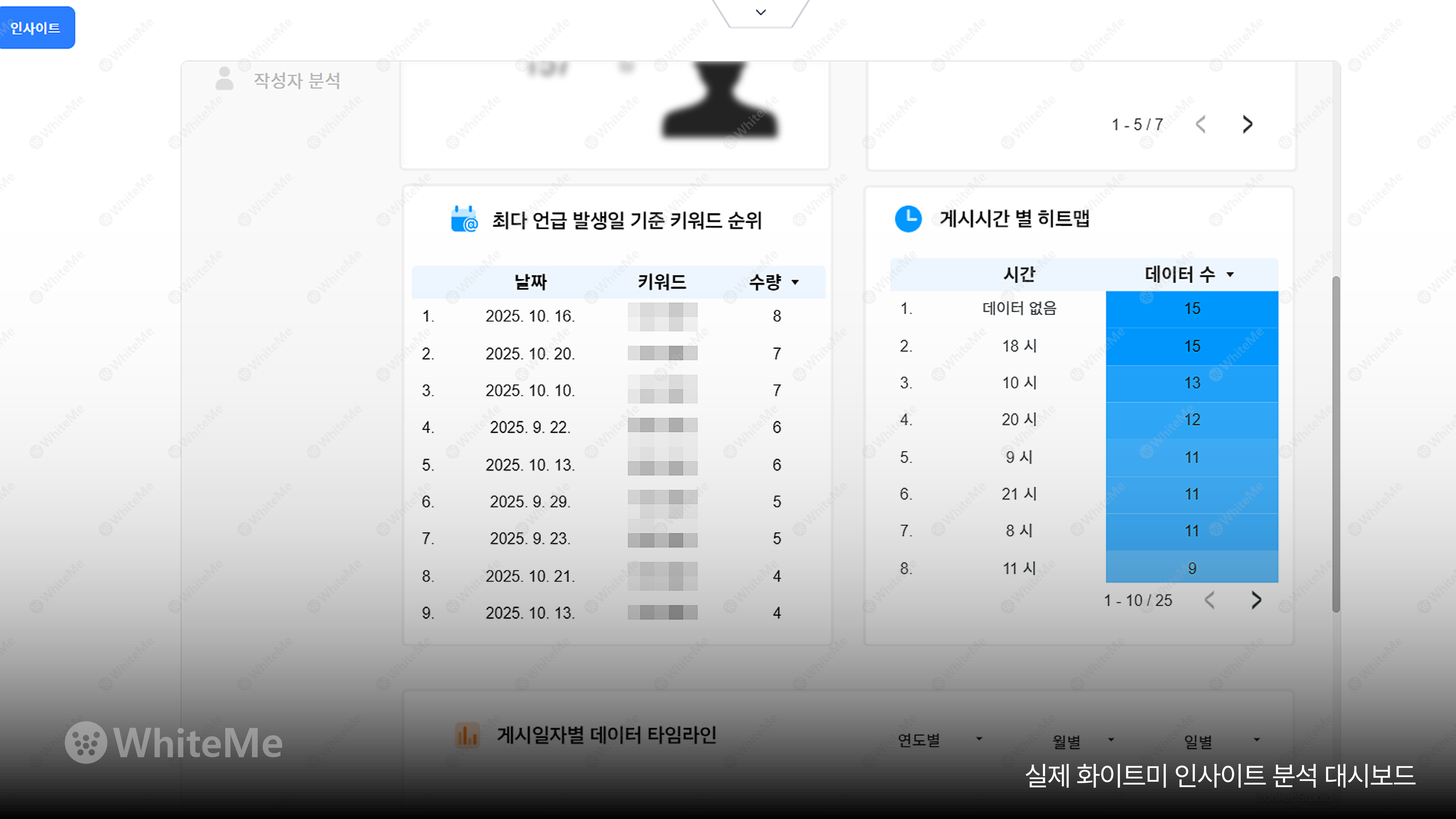
In the process, White Me reorganized dispersed data into a single flow to help identify the context in which the brand is being interpreted and what perceptions are being repeated.
Through this, we were able to understand in one flow the context in which the brand was being interpreted and what perceptions were being repeated. This process was not just a simple data integration, but also a task of unifying the perspectives within the organization.
VOC analysis approach that provides ‘judgment standards’ rather than correct answers
What was the most important aspect of your collaboration with White Me?
Do-Hyeon: The biggest thing was that it didn’t give the correct answer, but showed why this interpretation is repeated.
We did not provide any specific message or direction to Z Construction. Instead, we focused on explaining with data why the brand is being repeatedly interpreted and in what context.
By comparing the flow of brand perception in a time series before and after rebranding, we distinguished between interpretations that are decreasing and perceptions that are newly forming.
This process served as an opportunity to transform brand strategy discussions from ‘exchange of opinions’ to ‘evidence-based judgment.’
Continuous public opinion management required even after rebranding
What questions are you still asking at this point?
Dohyun: Is our brand being read with one voice now?
Rebranding is an important turning point, but it does not mean the end of brand management in itself.
This is because in the online environment, past perceptions can reappear at any time, and can spread a different meaning when combined with new issues.
In this way, the case of Z Construction Company clearly shows why ‘managing how it is read by the public’ is more important than renewing the brand after rebranding.
Managing brand perception ultimately means managing corporate trust, and this work is not a one-time project but an ongoing strategy.
Checking brand awareness and public opinion after rebranding

Checking brand awareness and public opinion after rebranding
Once rebranding is complete, many companies naturally want to move on to the next step. We focus on promoting the new message and publicizing the changed image.
But what is most often missed at this point is Checking public opinion after rebrandingno see.
While rebranding is the process of organizing “what the brand will say,” opinion polls are the process of determining how that message is actually being received.
Especially in the online environment, there are many cases where a brand is interpreted in an unintended context, or past issues and events are re-consumed with new messages. The problem is that this trend is not easily visible.
Even if negative issues are not revealed, certain keywords and interpretations are quietly repeated in public opinion, forming a brand image.
For this reason, post-rebranding opinion polls are not a confirmation of performance. The process of checking where brand awareness remainsmust be approached.
VOC & online public opinion must be analyzed together to reveal the structure of perception
So how should VOC analysis change after rebranding? The key is not to view VOC as simply ‘customer reviews’, but to interpret it in the same context as online public opinion.
The mistake companies often make here is that they often look at VOC and online public opinion separately when determining brand awareness. Roughly speaking, VOC is interpreted as a matter of internal operation, and public opinion is often interpreted as a matter of external image.
However, in reality, there are many more cases where the same perception is revealed in different forms than when two pieces of data tell different stories.
Therefore, repeated inquiries to the customer center lead to complaints in the community and evaluations in SNS, and if you try to isolate this flow, you often make the mistake of blurring the cause of the problem.
Conversely, if you connect VOC and public opinion into one context, the structure of how the brand is interpreted begins to reveal itself.
If certain perceptions persist even after rebranding, it is not because the message is lacking.This is because we do not properly see the path through which that perception is formed.It may be.
Public opinion awareness after rebranding, White Me VOC analysis service!
Public opinion awareness after rebranding, White Me VOC analysis service!
Brand management after rebranding is not about issuing more messages, but about accurately reading and judging the perception that has already been formed.
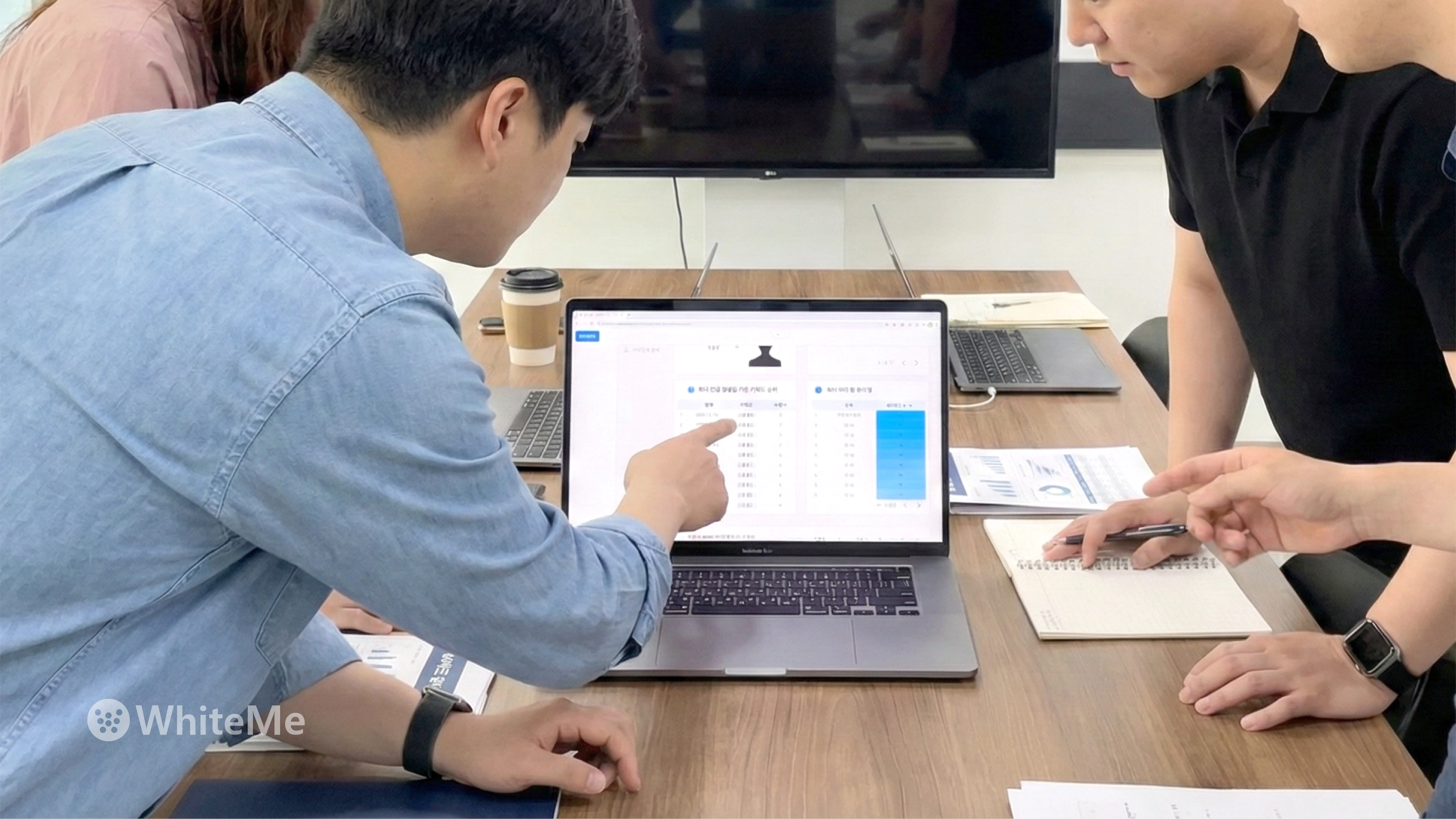
Rather than listing brand awareness, VOC, and online public opinion as separate data, White Me provides a 'VOC analysis service' that allows you to examine how they are connected to create a single brand awareness. Reputation for brand perception after rebranding
- Is it just a transitional period?
- Is it time for management?
- Is it time to adjust your strategy?
You can establish standards by which you can explain and judge for yourself.
If you're not sure if your brand still reads with one voice after your rebrand, what you need now is not additional campaigns. Data that helps you accurately understand your current perceptionIt may be.
After rebranding, White Me is not about making the brand ‘more visible,’ but rather going through the process of managing it so that it is read properly in the intended direction.

Even after a rebrand, there are moments when it's hard to be sure if your brand is being read the way you intended. Even if there are no notable issues,In public opinion and VOC, past perceptions may be repeated or messages may be interpreted differently.White Me analyzes brand awareness and public opinion through data to help you decide whether it is time for an inspection.
👉 Inquire about White Me service
※ This case image was created with AI to protect customers. White Me protects customer information in accordance with NDA.