


‘Splinternet era?’ in which overseas expansion becomes more detailed and demanding?
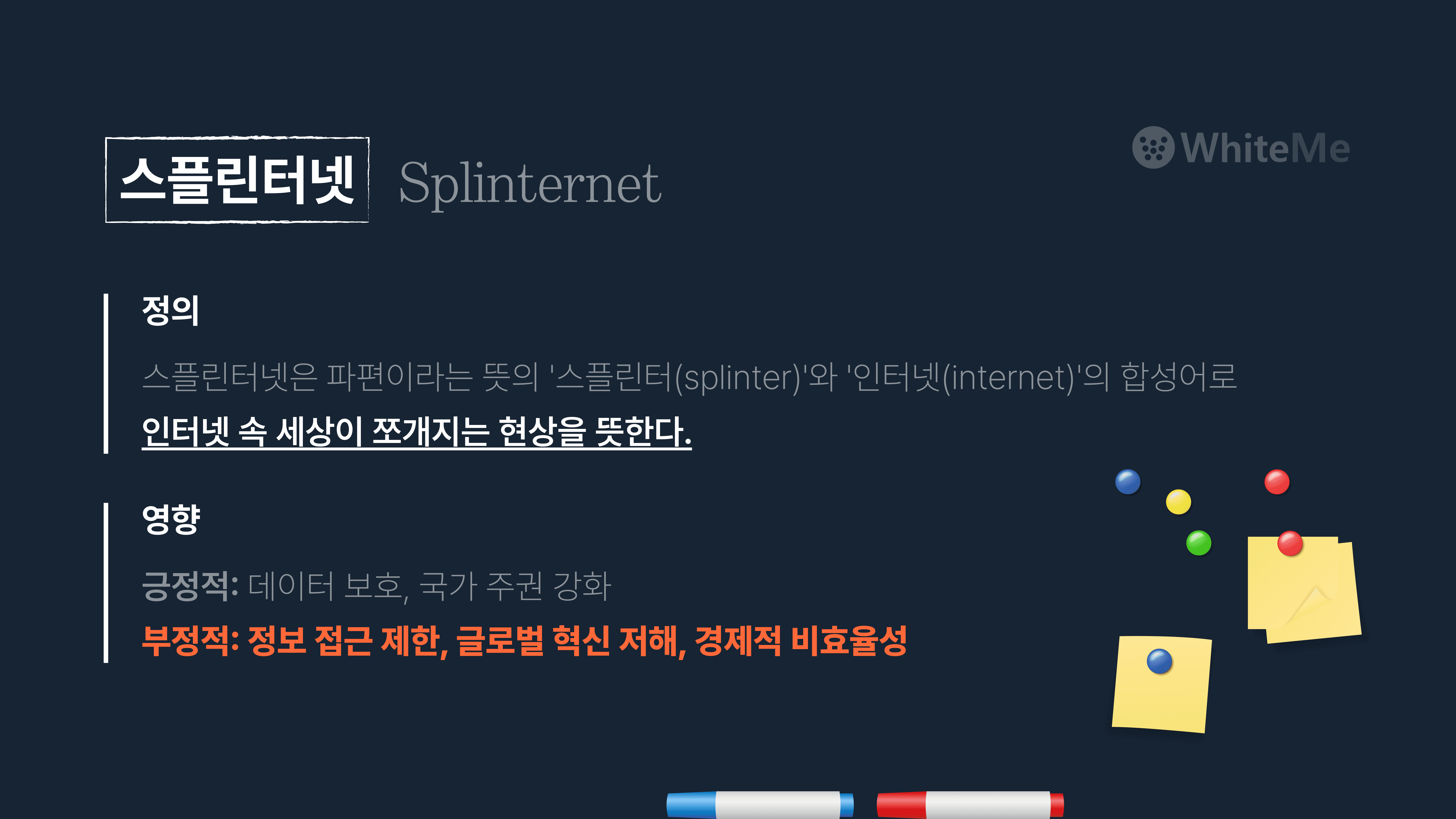
In 2025, ‘this phenomenon’ is intensifying on the Internet.
When the whole world was one internet
Just 10 years ago, the Internet was truly the ‘World Wide Web’. When you search on Google, the same results come out in both the United States and Korea, and you can use Facebook in the same way in any country.
Products ordered from online shopping malls could be shipped anywhere in the world.
But now things are completely different.Google and Facebook cannot be used in China, and in Europe, Apple had to pay a fine of over 800 billion won.
In the United States, regulations on Chinese shopping malls Sheein and Temu are being strengthened, and in Canada, you have to pay to use news links.
Splinternet phenomenon spreads in each country
- Canada: Obligation to pay royalties to media outlets when posting news links
- Australia: Google, Facebook pay $100 million annually for use of news content
- Brazil: Platform blocked and fined for spreading fake news
Different online regulations, what is ‘Splinternet’?
To explain this change easily, in the past, the whole world was like one big mart, but now each country is a different mart. Each supermarket had different rules, so even the same product was treated differently in each country.
Experts call this change ‘Splinternet.’This means that the once unified Internet is being divided into pieces by country.
Why is the Splinternet phenomenon a problem?
Why is the Splinternet phenomenon a problem?
It would be nice if these changes were simply 'diversity', but in reality, they are creating several serious problems.
firstBusiness complexity grows exponentiallyI'm doing it. In the past, if you created one service, you could use it all over the world, but now you have to create different versions according to different rules for each country. We are in a situation where we have to develop and manage it separately for Europe, America, and Asia.
alsoUnpredictable regulatory changesThis has made it difficult for companies to make long-term plans. Services that are legal today could suddenly be banned tomorrow, and you never know when or how new regulations will come out. In fact, many global companies are suffering huge losses due to unexpected fines or service blocking.
Above allResponse costs are rapidly increasingthere is. The costs of hiring legal experts in each country, building different systems for each country, and monitoring constantly changing regulations are significant. It has become difficult for small and medium-sized businesses to handle.
The corporate risk impact of the Splinternet phenomenon
What impact will this have on our company?
More companies are affected than you think
You may be thinking, “It doesn’t matter because we’re a small company.”In reality, more companies are affected than you might think.
This applies to any company that has some overseas customers, provides services overseas online, receives foreign investment, or plans global expansion.
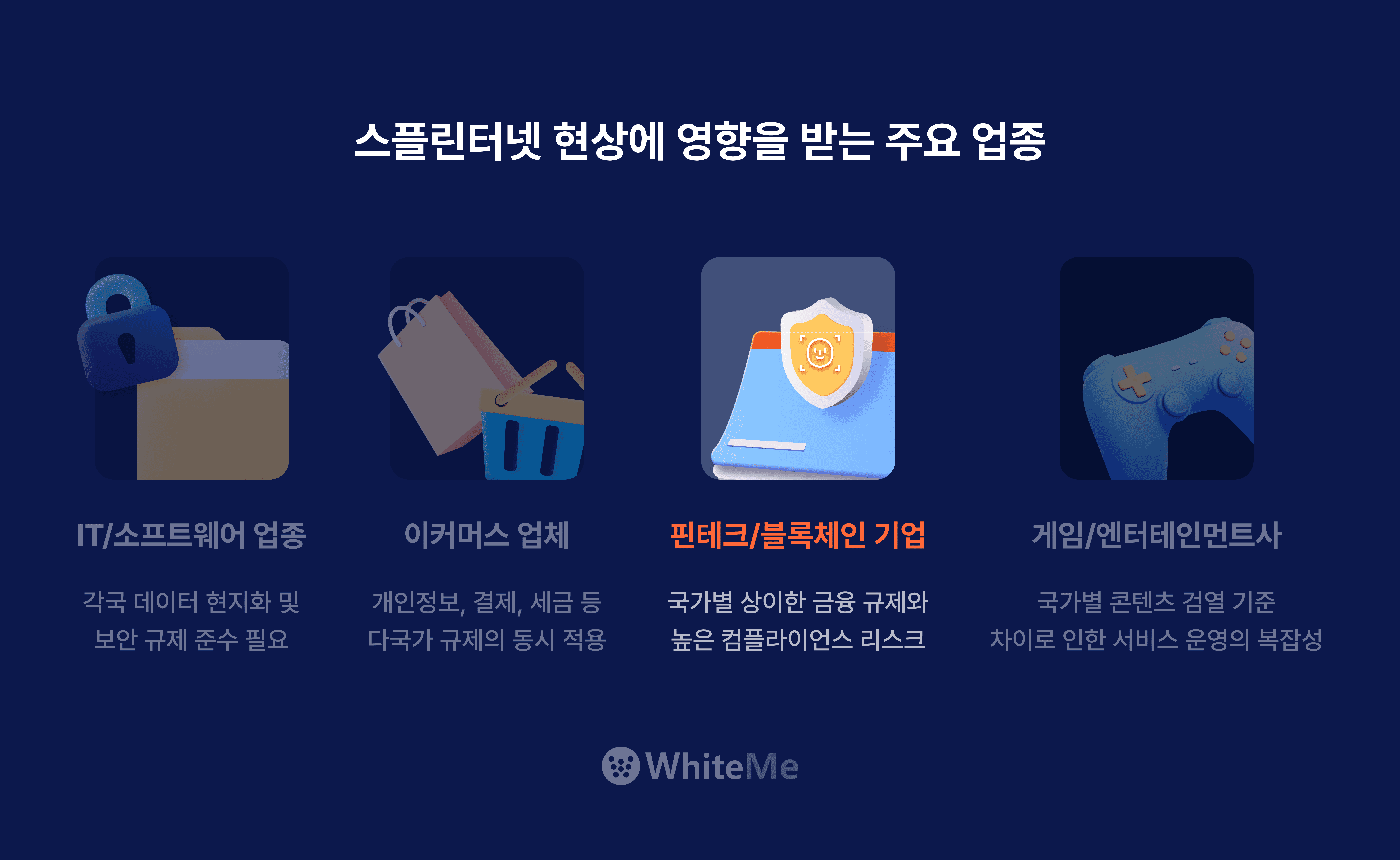
Key affected industries:
- IT/Software Company
- e-commerce company
- Fintech/Blockchain company
- Game/Entertainment Company
Types of damage caused by the actual Splinternet phenomenon
The biggest problem isIt's a sudden change in law.. Services that were fine until yesterday are becoming illegal starting today.
Even if you say, “I didn’t know,” you still have to pay the fine, and the amount is quite high. There is an increasing number of cases where even small mistakes are subject to fines worth tens of billions of won, and there are even situations where you have to pay a fine of 10% of sales.
What is more serious is the impact on the company image.If you are labeled as a “company that violates the law,” you will lose the trust of your customers and investors will turn away.There are also separate court battle costs.
🌍 In the era of online regulation, the limitations of traditional reputation management methods are
Limitations of the traditional reputation management method of “losing the cow and repairing the barn”
Fatal weakness in reactive response
until nowReputation management used by most companies is a typical “reactive” approach.It was.
When a personal information leak incident occurs, they only respond after media coverage and a surge in customer complaints, and when they are notified of a GDPR violation, only then do they hire a lawyer and begin negotiating a fine.
But in the Splinternet era, this approach no longer works. This is because regulations in each country are complexly intertwined, and problems that occur in one place quickly spread throughout the world.
In case of violation of GDPR, there is an obligation to report to the authorities within 72 hours, so if it is late, additional fines will be imposed. In case of personal information leakage, immediate customer notification is required, so if it is late, you will be exposed to the risk of class action lawsuits.
Problems with existing reputation management methods
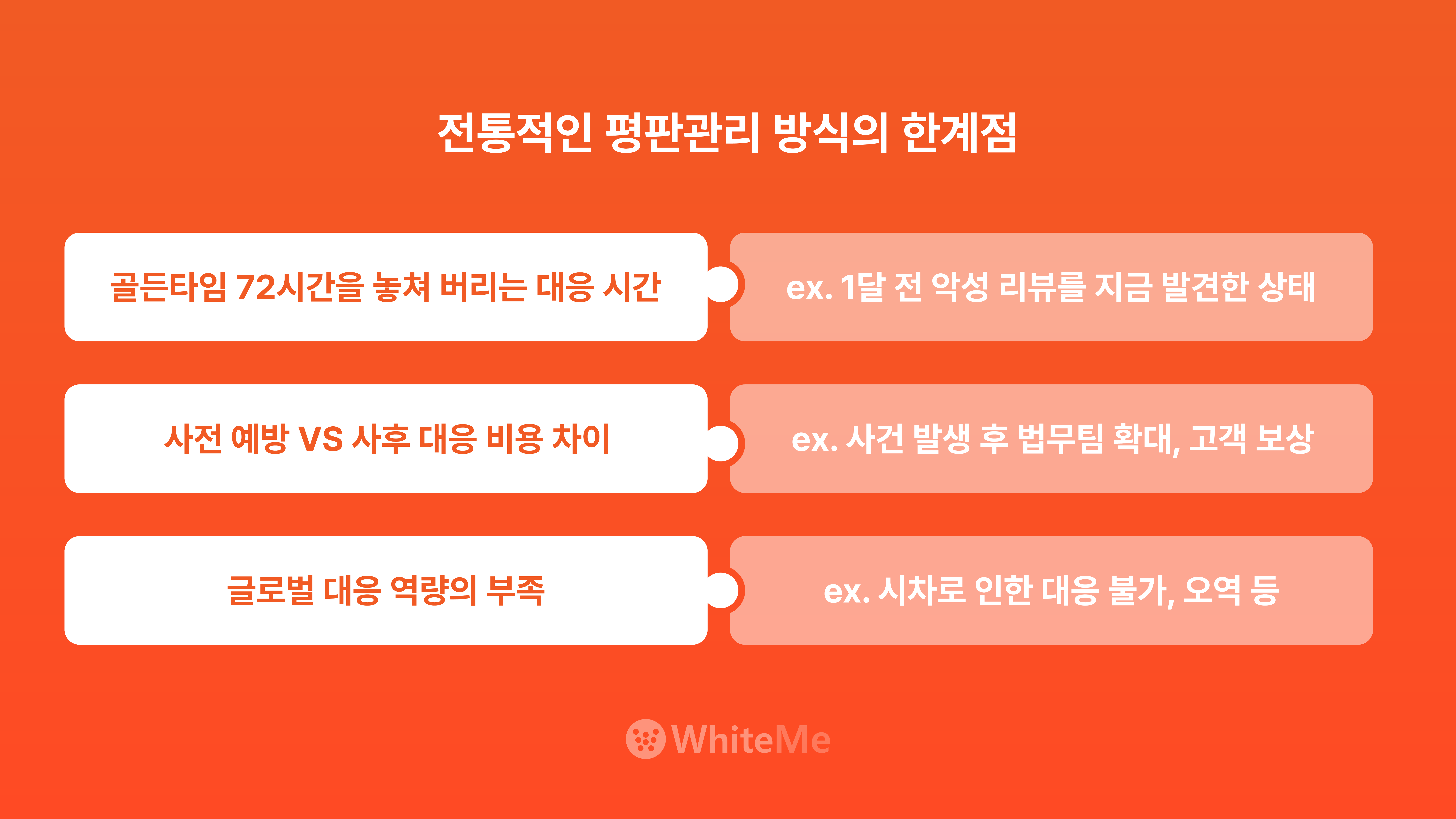
No relief within 72 hours of golden time
In case of malicious postsIf you do not respond within 3 days, it will be stuck in the top search rankings.It becomes very difficult to delete later.
Cost differences between proactive vs. reactive
Pre-monitoring costs about 1 to 5 million won per month depending on the size of the company, but post-crisis response costs 5 to 5 billion won for 3-6 months.
If you include fines and litigation costs, you'll see an average of 100-100 billion won, and considering sales losses, you'll see an average reduction of 20-40%.
Lack of global response capabilities
Errors in interpretation due to language barriers in each country's regulatory documents, inability to respond immediately due to time differences, lack of understanding of local laws and cultural differences, etc.When a complex effect leads to an incorrect responseThere are a lot.
Case studies of global big tech companies failing to respond

Case studies of global big tech companies failing to respond to regulations
Meta's failure to respond to European DMA
- direct damage: KRW 1.5064 trillion
- indirect damage: 10,000 employees for 2 years
- opportunity cost: If a new service is developed, profits of 1 trillion won are possible.
Mehta's case shows how serious these problems are.The new Digital Markets Act (DMA) came into effect in Europe, and Meta failed to properly comply with it and ended up being fined.
Additionally, 10,000 employees had to work on solving this problem for two years. UnfortunatelyIt is estimated that if a new service had been developed during that time, the company could have made about 1 trillion won in revenue, which was thrown away as a fine.In the end, it was a loss that could have been avoided if one had prepared in advance.
Damage type
specific loss
note
direct fine
KRW 1.5064 trillion
EU Commission imposes
system change fee
Specific figures unconfirmed
11,000 employees working 590,000 hours
opportunity cost
Specific figures unconfirmed
Delay in new service development
brand value
30% drop
Brand Preferences in the EU
Source 1: EU Commission 'brakes' the transition to Meta paid services...concludes DMA violation
Source 2: EU imposes 1 trillion won fine on Meta... suspected of violating anti-monopoly law
14 years of regret after Google withdrew from China
- missed opportunity: Giving up 40 trillion won market over 14 years
- Competitor's Success: Great success in China during the same period
In 2010, when the Chinese government demanded censorshipGoogle refused and withdrew from China.At the time, it was evaluated as “keeping the principles”, butLooking back now, 14 years later, there are many regrets.
The opportunity Google missed was a market worth 40 trillion won over 14 years.
During the same period, Apple achieved great success in China. What if Google had found another creative solution? Principles are important, butIt teaches us that sometimes a flexible approach is needed to suit the situation.
item
At the time of 2010
2024
scale of loss
market share
30% (No. 1 in China)
0% (complete expulsion)
loss of market
annual revenue
300 million dollars
0 dollars
100% reduction
Cumulative opportunity cost
-
$40 billion (approximately 55 trillion won)
Total loss over 14 years
Competitor Performance
-
Apple annual revenue: $70 billion
widening gap
market position
No. 1 in search market
baidu exclusive
completely replaced
Source: What does China plan to do now after banning Google 15 years ago?
🌍 [Case] Case of Company A, which turned the Splinternet phenomenon into competitiveness
Companies that prepare early avoid more risks.
Preemptive response by fintech startup company A
Company A operates an AI-based personal investment platformwas a fintech startup with 120 employees and annual sales of 15 billion won.
It provides robo-advisory services in 15 European countries and has 500,000 users. Key features included AI portfolio recommendations, automatic rebalancing, and investment advisory services.
At the end of 2023, Company A heard that discussions regarding the EU AI Act were becoming more active.As a result of analyzing 47 provisions related to Company A among the 770 provisions of the EU AI Act, it was expected that the investment advisory AI system would be classified as high-risk AI and subject to strict regulation. They had to comply with mandates such as algorithmic transparency disclosure, bias testing, and regular audits.
At the time, most competitors were taking a wait-and-see approach, saying, “It’s still in the draft stage, so there’s time,” some large companies were reviewing it with their own legal teams, and small and medium-sized companies weren’t even able to accurately understand the contents of the regulations.
‘White Me’ service for rapid response to overseas regulations
The CEO of Company A looked at Meta’s failure to respond to DMA andDecided that “it is impossible without expert help”We asked White Me for consultation.
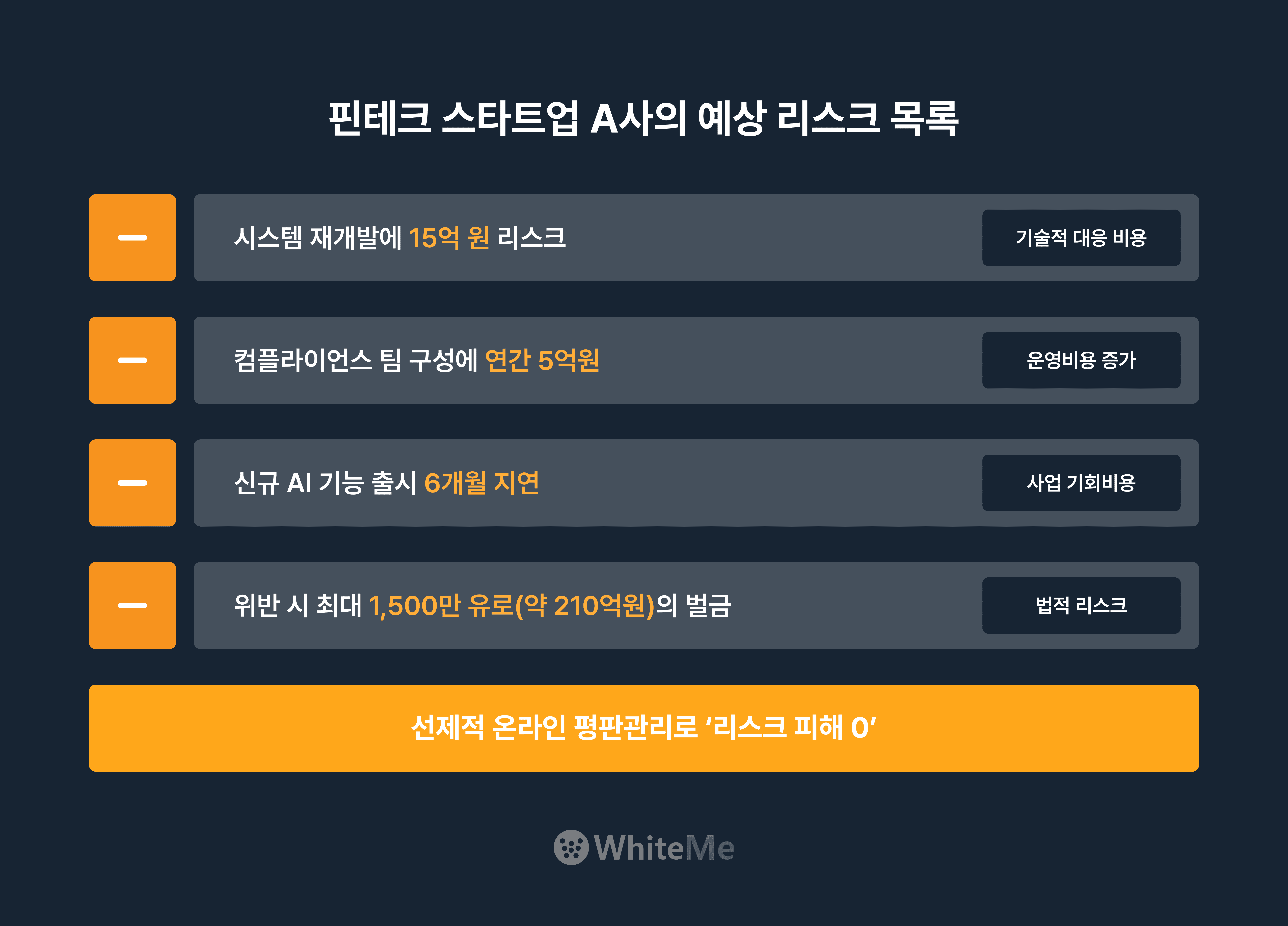
The risks expected by Company A were 1.5 billion won for system redevelopment, 500 million won per year to form a compliance team, a 6-month delay in launching new AI functions, and a fine of up to 15 million euros (approximately 21 billion won) in case of violation.
Therefore, we began systematic preparations with Company A based on the risks expected by Company A. We tracked trends in 27 EU countries and Korea through real-time regulatory monitoring in 28 countries, and analyzed AI-based impact.We provided a weekly risk report by filtering only provisions related to Company A's services.
item
Company A (White Me)
Competitor average
improvement effect
response preparation period
6 months (advance)
4 months (postmortem)
50% reduction
service interruption
0 days
Average 52 days
completely prevent
Fines/Sanctions
0 won
Average 480 million won
100% prevention
new releases
2 months ahead
6 month delay
8 months difference
Performance in responding to reputational risks before the law was revised
When the EU AI Act was officially implemented in March 2024, Company A was fully prepared. Especially when other competitors are scrambling to find a quick response,Company A was able to focus on developing new services with ease.
Even the ‘crisis’ of the Splinternet era can be transformed into competitiveness.
The most surprising thing is that Company A completely turned this situation into a competitive advantage.
Additionally, while competitors were struggling to respond to regulations, Company A was able to launch new AI features six months earlier.Investors also highly evaluated the company as “a company with excellent risk management capabilities,” and as a result, we were able to attract Series B investment at an amount 30% higher than our target.
Thankfully for this achievement, the CEO of Company A“Thanks to preparing with White Me, regulations are no longer a concern, but a competitive advantage. Now, I am not afraid of new regulations.”He expressed his thoughts.
Why is White Me’s regulatory monitoring necessary?
The biggest strength of our White Me isWe already have real-world experience managing over 250,000 online posts from 28 countries.I have accumulated know-how through first-hand experience of each country's different legal systems, cultural differences, and communication methods with government agencies, so I have actually experienced the regulatory environments of various countries, from Europe's GDPR response to Japan's Personal Information Protection Act and Singapore's digital regulations.
1. Monitoring of 40 countries capable of detecting real-time regulatory changes
Immediately capture digital regulatory changes in over 40 countries with 24-hour real-time monitoring.It tracks key regulatory agencies in each country in real time, automatically calculates impact on a 0-100 scale, and provides priority notifications. In addition, we present response plans tailored to the characteristics of each country's platform through regional customized strategies.
2. Legal risk prevention system
Detects posts related to regulatory violations in real time and automatically collects legally binding evidence. At this time, response is differentiated by risk level, with Critical responding within 24 hours and High responding within 72 hours. In addition, we provide expertise based on experience deleting 250,000 cases.Malicious publisher pattern analysis is possible.
- White Me’s Differentiated Strengths
- English: Google/Reddit
- Japan: Yahoo Japan/Twitter
- Greater China: Weibo/Xiaohongshu
It boasts a high deletion success rate for each overseas platform and an average reporting processing speed of 3.2 days.We provide one-stop service and support linked to a law firm from monitoring to legal response.
🌍 Prepare for the changing Splinternet era with White Me.
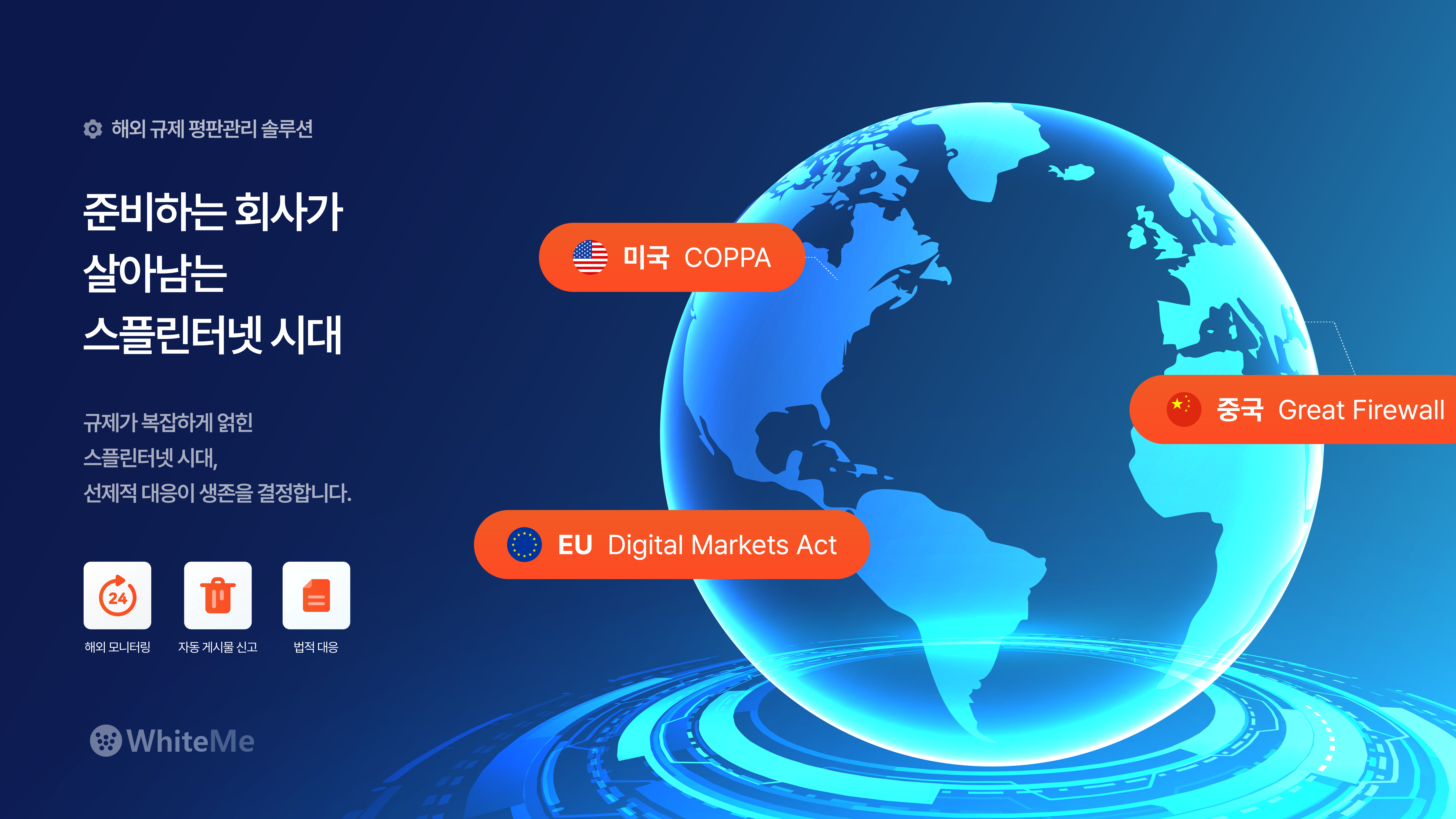
Prepare for the changing Splinternet era with White Me.
In the past, you could have thought that all you had to do was expand Korean services overseas, but now things have changed.
Laws are changing frequently, and the speed of change is accelerating. Instead of the complacent thought of “If a problem arises, let’s solve it then,” we need to have a proactive attitude of “Let’s prevent problems before they arise.”
If you look at successful companies, they have something in common.Prepare in advance to turn crises into opportunities, communicate well with the government and customers, adapt quickly to changes, andIt means acting one step ahead of others.
White Me, based on practical experience in 28 countries, works together to help customers manage their long-term online reputation so they no longer have to fear regulation.
Although we live in the complex Splinternet era, safe and successful global business is possible with the right partner.
“Regulatory changes that companies entering overseas must be aware of.” If you are interested in global regulatory monitoring, join White Me now.[Service inquiry]