

81% of applicants check company reviews before interview
81% of applicants check company reviews before interview
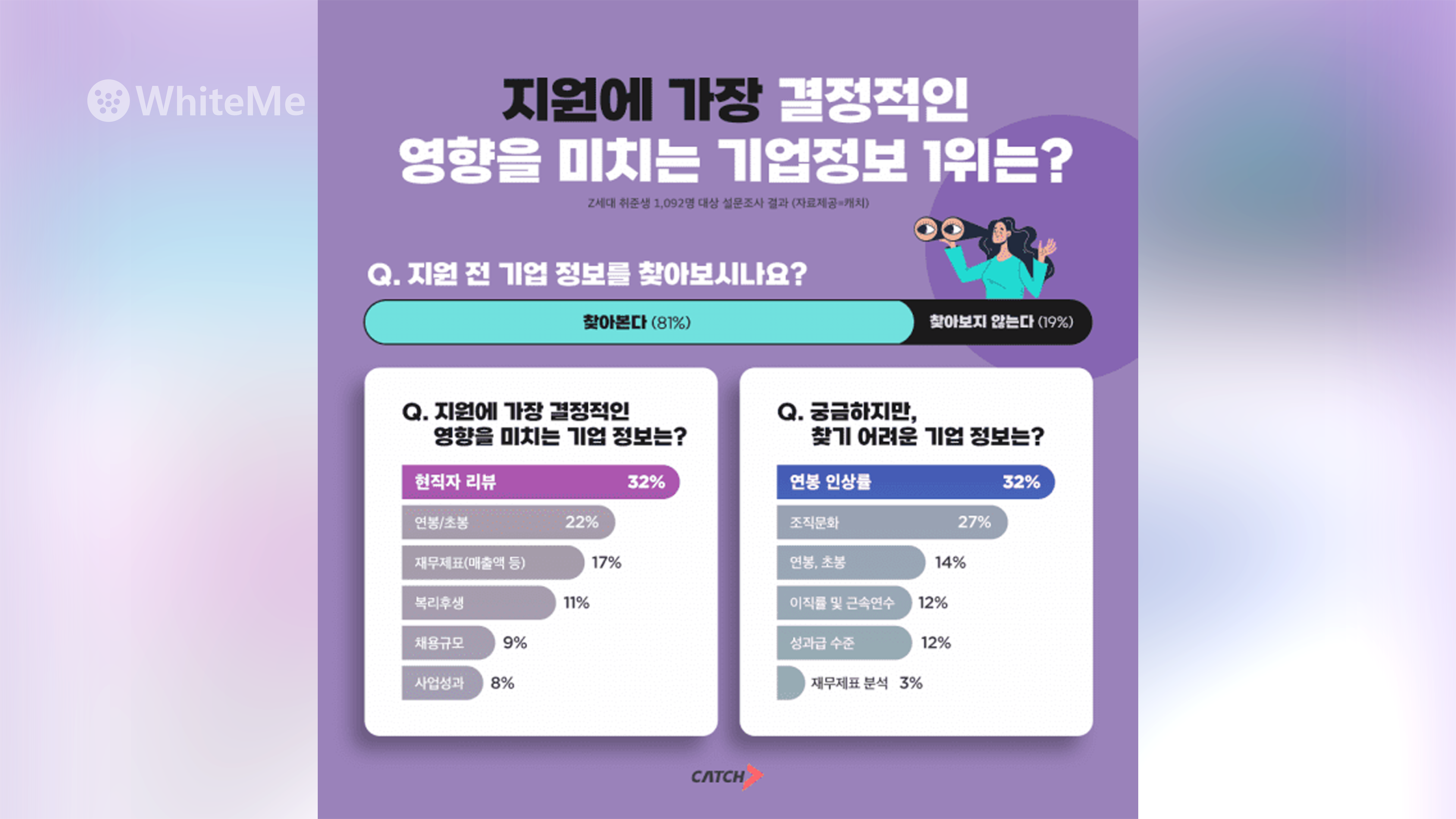
In the recent job market, there is an increasing number of cases where applicants first check the reputation and information about a company before applying or participating in an interview. In fact, a similar trend was confirmed in a survey conducted by Catch, a graduate school, on 1,092 Generation Z job seekers.81% of respondents answered that they search for company information before applying to a company.
The reasons why people search for information are also interesting. The biggest reason was to use it to fill out an application and prepare for an interview (48%), followed by not knowing what kind of company it was (34%), and to understand the work environment and atmosphere (8%). Now, the process of researching company information in advance seems to have become a natural step in preparing for employment.
What particularly stood out was the information they considered most important when deciding whether to apply.
‘Reviews by incumbents (32%)’ ranked first. We can see that job seekers' standards for understanding companies are changing in that they refer to actual worker experience rather than salary or financial information.The official information provided by the company alone is not enough, and a trend of checking external reviews and reputation is becoming established.
Perhaps that's why, since I participated in the interview while already having access to a lot of information, the atmosphere of the actual interview site felt quite different from the past. In the past, job postings or company introductions were the starting point for understanding a company, but now search results or review content often take the place of that role. The number of scenes where an applicant's first impression influences the direction of the conversation is naturally increasing.
Therefore, interviews in the digital age are becoming more of a process of checking whether the information the applicant has seen in advance matches reality rather than a place to introduce the company for the first time.
Additionally, this case can also be seen as a story that shows how these changes appear in actual recruitment sites.
Are the repeated questions from applicants a coincidence?

Are the repeated questions from applicants a coincidence?
Meet Seoyeon, the HR lead of Company B, which provides collaboration solutions for businesses.
Company B, the protagonist of this case, is an IT company that provides collaborative SaaS solutions for businesses. After the Series B investment, the size of the organization quickly grew to about 180 people, and hiring was expanding, focusing on developers, PM, and B2B sales positions.
When an organization is growing, the hiring experience itself can become an important point of contact in forming the company image.
Especially in an environment where competition for talent is fierce, the applicant's perception of the company when he or she comes to the interview is bound to affect the overall hiring process. The first person to feel this change was Seo-yeon, HR team leader at Company B.
Hello Seoyeon, I heard that this is a period of rapid growth for the organization. What is your current role and what do you see as important from an HR perspective?
Seoyeon: Hello, I am Seoyeon, the HR team lead at Company B, which provides a SaaS-type collaboration solution for enterprises. I am in charge of overall HR, from recruitment strategy to interview process operation and work related to organizational culture. Recently, as the organization has grown rapidly, we are continuously checking the overall flow of applicants and what experiences they have as they enter the hiring process.
During the scale-up process, was there a moment when you felt your hiring experience had an impact on your perception of the company?
Seoyeon: I experienced the process of organizational growth at a startup twice. In the process, I felt that recruitment was not simply about adding human resources, but was directly related to HR branding.
Before this case, had you ever felt that the applicant was already entering the interview with a negative perception or image of the company?
Seoyeon: I was aware of the impact of corporate online information on applicants, but this was the first time I felt that the interview atmosphere itself had changed. As similar questions kept coming up over and over again, I thought it couldn't be a coincidence.
As such, Seo-yeon was an HR lead who not only carried out recruitment operations but also consistently observed how applicants understood and entered the company. And that change started with small differences that were repeated in the interview scene.
The interview didn't really change, but as time went by, it was noticeable that applicants started asking similar questions first.
As the number of applicants for different job categories increased to check the working environment or organizational atmosphere before hearing the company description, this kind of talk naturally began to arise within the team.
“What information are applicants already seeing and coming in?” With that question as an opportunity, Seoyeon Reed began to look at the reasons for the changes that were occurring in the interview scene one by one.

Repeated confirmation questions, it wasn't a coincidence
While you were recruiting, there must have been a moment when you felt different from before. In what areas did you feel the need to check Company B's online reputation?
Seoyeon: At some point, similar questions started to keep coming up in interviews. These questions were designed to check what the working environment or organizational atmosphere was really like and whether what they saw online was true. At first, I thought it was just a matter of interest to some applicants, but as the same questions continued to be asked regardless of job type or experience, I thought it was not just a coincidence.
The reason why Seoyeon Reed became convinced of change started from something smaller than expected.
Company B aims to reduce the commuting convenience and housing burden of its employees. Welfare system that operates dormitory facilitieswas providing. In fact, it was a system that was operated internally considering the convenience of employees.
However, at the top of the premium welfare review tab on the Job**nit company rating site, A negative review stating that providing dormitories felt like a work burden.was being exposed.
It was a short sentence It was an expression that left a strong impression., if read without context, it could lead one to accept the company's entire working environment in a conclusive manner. It is said that from then on, he began to understand little by little where the questions that were repeated during the interview came from.
- “Do you tend to work overtime a lot?”
- “Is the organizational atmosphere actually very intense?”
- “Is the welfare system similar to what I saw in the reviews?”
In fact, applicants interviewed after the review was posted often asked questions that seemed to confirm information they had already heard, rather than asking for new information. Accordingly, Seoyeon Reed began to feel like the interview was not a place for the company and the applicant to get to know each other for the first time, but rather a place where the applicant unilaterally verified the perception formed online.
The problem was that before the interview, my first image of the company was already being formed through search results and company reviews.
From this point on, under the leadership of Seo-yeon, the HR team remembered that the starting point for repeated questions may be perceptions created externally rather than internally within the organization, and began to expand the criteria for viewing the ‘applicant’s recruitment experience’ from internal to the online environment where the applicant encounters the company for the first time.
The problem was not internal, but in the way applicants met the company.

The problem was not internal, but in the way applicants met the company.
If there were no internal changes but the recruiting atmosphere had changed, I think you would have thought it was an internal problem at first. Was there a moment that made you change your perspective to the applicant side?
Seoyeon: That’s right. At first, we tried to find the reason within the organization. I checked one by one to see if there were any problems with the interview method or communication process. However, I couldn't see any clear changes. From then on, I started to change my perspective a little. I thought, ‘Maybe it would look different from the applicant’s perspective rather than ours.’
To find the reason for the change in the atmosphere between the company and the interviewee, Company B's HR team first examined the inside of the organization. This was to check whether there were any changes in the interview method or communication process. However, no clear cause has been found to explain this. As it became difficult to find answers internally, attention shifted to the process by which applicants encounter the company for the first time.
When we revisited the search process from the applicant's perspective, things began to flow. This is because the first few things that appear in search results and company review pages determine the overall impression of the company.
Because applicants have to judge companies in a short period of time, it is difficult to compare all information.In the end, I came to understand the company based on what I first encountered, and in the process, a situation was created where certain expressions in the review were perceived as being larger than the actual context.
These problems made Seoyeon Reed rethink her approach. It is difficult to make changes just by responding to individual reviews, and we have come to feel the need to structurally examine the corporate reputation that is formed externally.
Afterwards, Company B conducted a reputation diagnosis with Whiteme. Whiteme analyzed search results and corporate review exposure status from the applicant's perspective and selected reviews that were influencing actual perception formation. We deleted and continued to manage problematic reviews through legal explanation procedures in accordance with the platform policy and contact with the platform operator.
Changed recruitment experience after recovering corporate reputation
What was the first change you noticed in the recruiting field after the company's reputation was restored?
Seoyeon: The first thing that changed was the atmosphere of the interview. Previously, many questions were asked to check whether the reviews were true, but later questions naturally followed about what kind of experience one could have at the company.
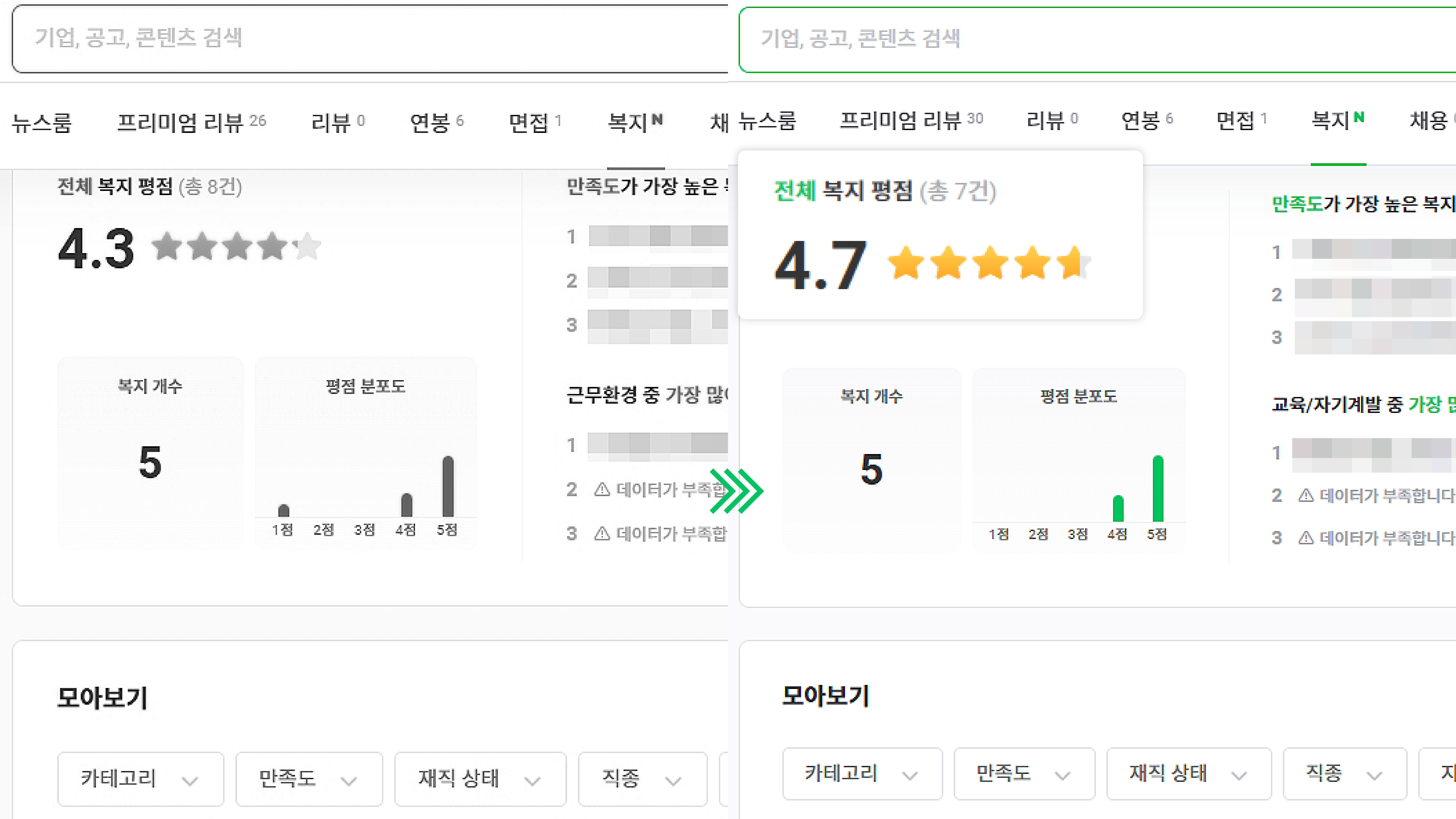
After organizing the reviews, Company B’s corporate rating was Increased from 4.3 to 4.7I did it. However, the change that the HR team noticed occurred in the hiring process rather than numbers. This is because as the standards by which applicants view the company change, the role of the interview itself begins to change little by little.
Previously, a significant part of the interview involved correcting perceptions of the company, but with the introduction of reputation management, more time can be spent on conversations between the company and the applicant to confirm each other's expectations. It was the same hiring process, but as the starting point changed, the nature of the conversation changed.
This case shows that reputation management is not just about increasing scores.
This was an example that confirmed that when an applicant's first impression of a company changes, the conversation and experience during the hiring process can also change.
3 ‘information contact points’ that the hiring team should check first
3 ‘information contact points’ that the hiring team should check first
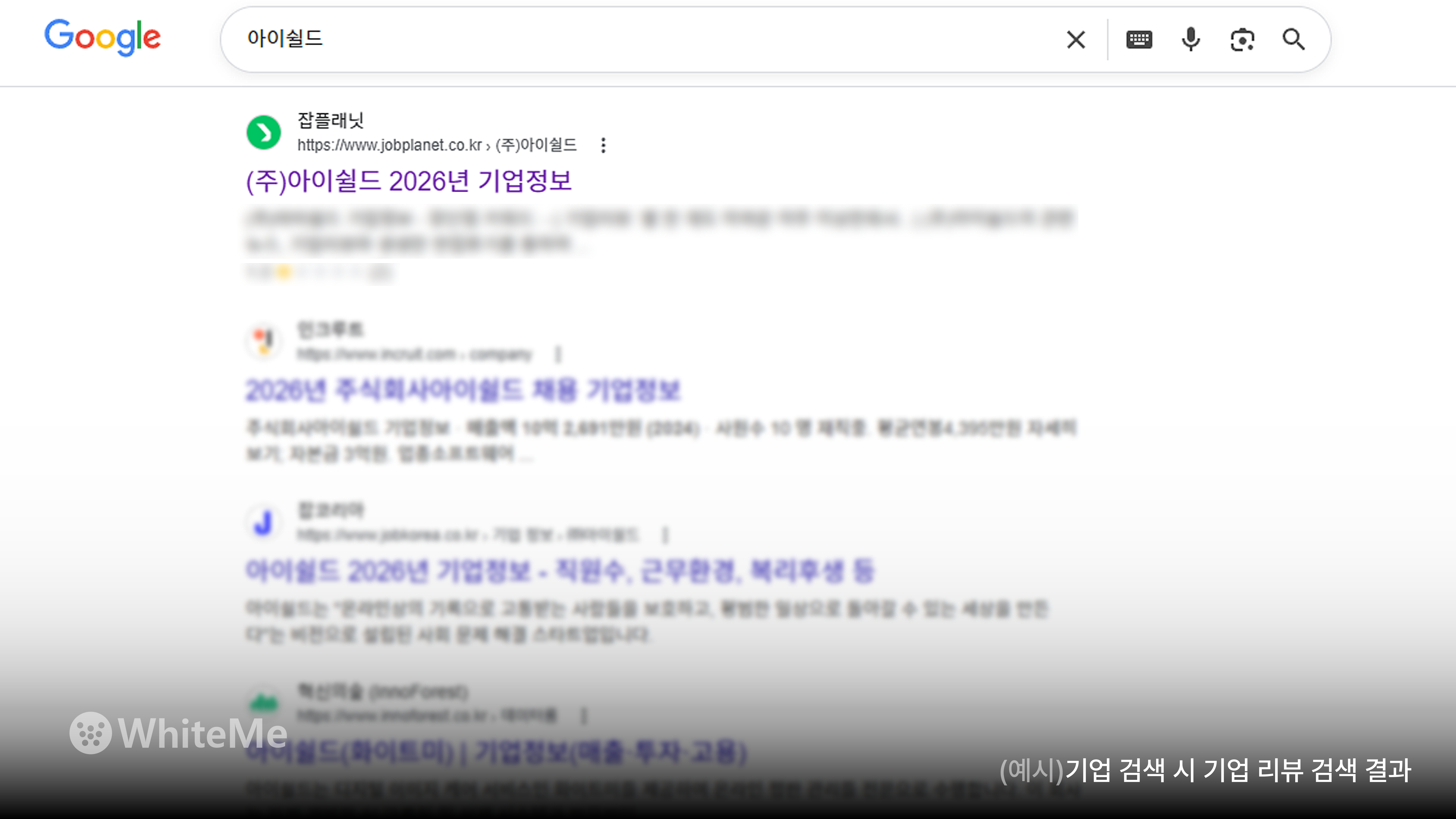
The case of Company B shows that recruitment reputation management can begin with examining the information environment in which applicants first encounter the company, rather than responding to a specific problem. So, what point can the hiring team check first?
- Company name search results on portal site
- Details of reviews on corporate rating sites
- Understand the nature of applicant questions during interviews
The first is the first screen that applicants see when they search for a company name.The information and keywords displayed at the top of search results serve as the starting point for applicants to understand the company. In many cases, the first impression formed on the search screen rather than a job posting or official website serves as a basis for subsequent recognition.
The second is the review content that is typically displayed at the top of the review rather than the overall rating.Applicants often judge a company based on a few sentences rather than reading all the reviews in detail. It is necessary to examine whether specific expressions are being accepted as an impression that represents the atmosphere of the entire organization, regardless of context.
The third is the flow of questions that appear repeatedly during the interview process.If you are consistently asked questions about the work environment or organizational atmosphere, this may be a sign that external perceptions are influencing you rather than changes in internal operations. Interview questions are not just conversation content, but are also an indicator of what information the applicant is based on to understand the company.
Changes in the hiring experience often first appear in small signs rather than suddenly. If you feel that the interview atmosphere has changed from before, you need to look into the cause not only from within the organization but also from the applicant's information point of contact.
Is it legal to delete business reviews? Is it really okay?
Is it legal to delete business reviews? really… Is it okay?
“This… isn’t there a legal problem with deleting reviews?”
“If the author files an objection, will it be uploaded again?”
“If I touch it for no reason, wouldn’t the issue become bigger?”
When we introduce the case of Company B, there is one thing that hiring managers check first.The question is whether there are legal issues with the review deletion or management process, and whether it is ever reposted after deletion.
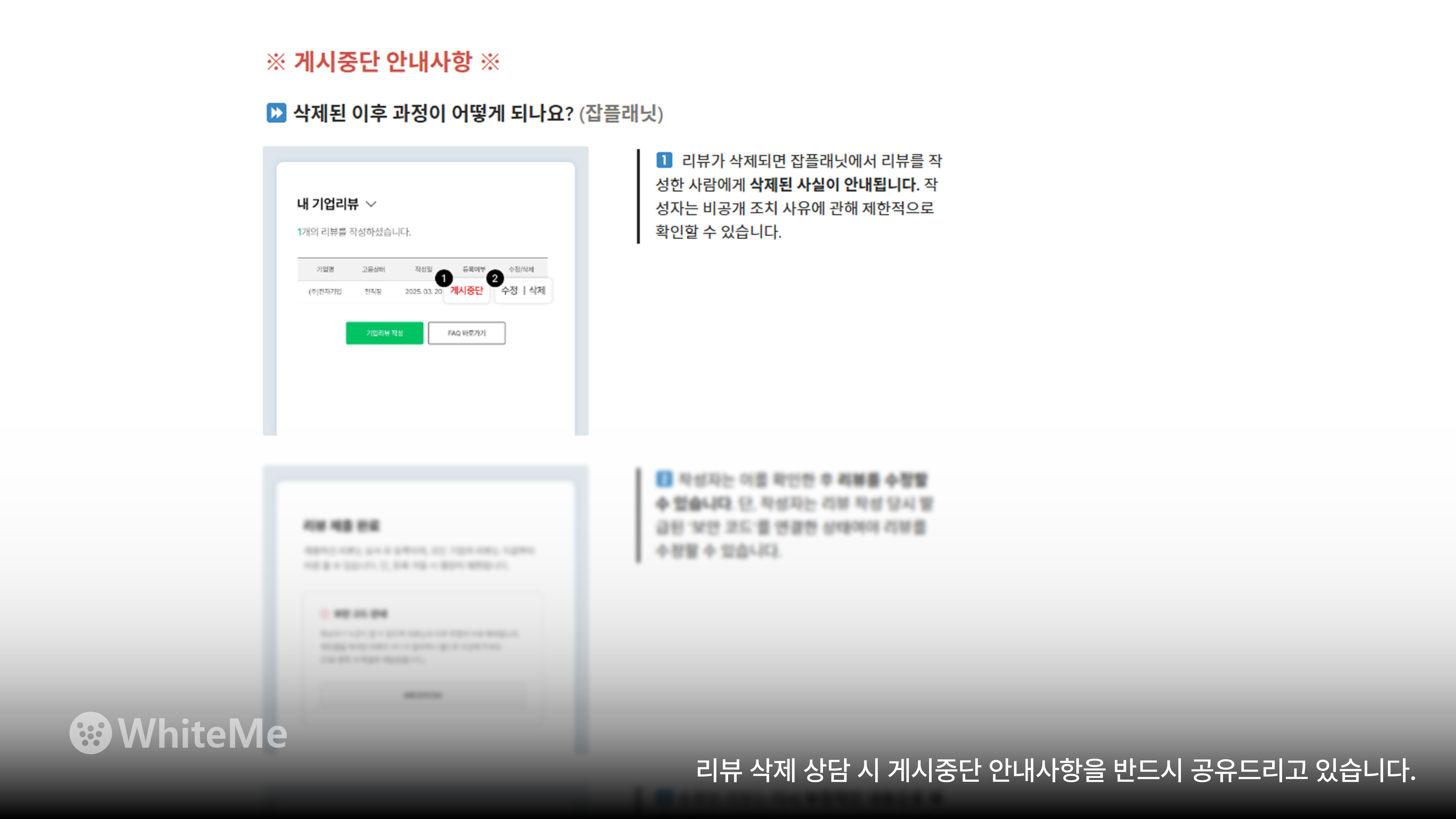
Posts on corporate review platforms are subject to the Information and Communications Network Act and platform operation policies in the same way as general online posts.
Therefore, if it contains content that is different from the facts or if elements of rights infringement are identified, a system is in place to request suspension of posting and provide explanations according to established procedures.
Deletion of reviews is not a method of arbitrarily removing content by a company, but rather a structure in which judgment and action are made ‘within the official process operated by the platform.’
Therefore, when a request to take down a posting is received, the author is also notified of the relevant facts, and the author can request reposting through an objection.
In other words, the procedure is not decided at the request of one side of the company, but is operated in a way that considers the rights of both the creator and the company.
Next, what many companies are particularly concerned about isWill deleted reviews be re-uploaded?It is. Due to platform policy, the possibility of reposting through objection exists.
However, when carried out based on sufficient evidence and accurate explanations, cases leading to actual re-posting are limited, and even in practical operations, the re-posting rate is mostly managed at a very low level of less than 10%.
Ultimately, the factor that has the greatest impact on the results isIt depends on the accuracy of the initial explanation and compliance with the procedure rather than on whether or not to delete it itself.
Another important point is that the purpose of reputation management is not to eliminate negative opinions.
This is closer to the process of organizing information that does not meet policy standards or may distort the context so that it does not represent the first impression of the company. When conducted within platform regulations and legal standards, both companies and applicants can begin the hiring process based on more balanced information.
Key takeaways
- Deleting a review Official procedures in accordance with law and platform policies
- It is not a structure where the company directly deletes Based on platform judgment
- Author Appeal possible, unilateral action
- There is a possibility of reposting Actual cases are limited to less than 10%
- Reputation management ≠ Not just deleting reviews Distorted first impressions
Repetitive interview questions may be a sign of a hiring reputation check

Repetitive interview questions may be a sign of a hiring reputation check
Many companies often think about reputation management only after a problem has occurred. However, in reality, small signs such as interview questions or changes in the external atmosphere toward a company sometimes appear first.
White Me does not respond to this situation by simply deleting reviews, but approaches it through a process of thoroughly examining and managing the ‘corporate reputation management life cycle’, such as how applicants understand and join the company.
Are you experiencing the following changes repeatedly? If so, it may be time to check our company's reputation.
- Similar confirmation questions are asked repeatedly during interviews.
- Questions about company reviews come before company descriptions.
- Conversations begin based on specific content, perceptions, and images.
- The hiring manager's explanation and explanation time for questions is taking longer.
- It is believed that there is no internal problem in the slow recruitment.
Managing a company's recruitment reputation can begin with understanding applicants' recruitment experiences, rather than responding after a problem occurs.

If the interview experience is different than before, it is likely that the applicant already has an understanding of the company based on online information. Check your current corporate reputation with White Me.
⭐White Me Corporate Review Delete Service Details Page
👉Contact Us to Delete Company Reviews
※ This case image was created with AI to protect customers. White Me protects customer information in accordance with NDA.