


What is the first point of contact for customers in Greater China with the brand?
The way domestic brands meet overseas customers has become more complex than before.
In the past, customer influx occurred through relatively predictable channels such as search advertisements, official websites, and acquaintance referrals, but now review content, SNS, and community reactions often have a direct impact on actual visit decisions.
In particular, overseas customers do not judge a brand solely based on the description provided directly by the brand. We form an impression of the brand by checking what the actual visit experience was like, what the comment atmosphere is like, and what issues are mentioned repeatedly.
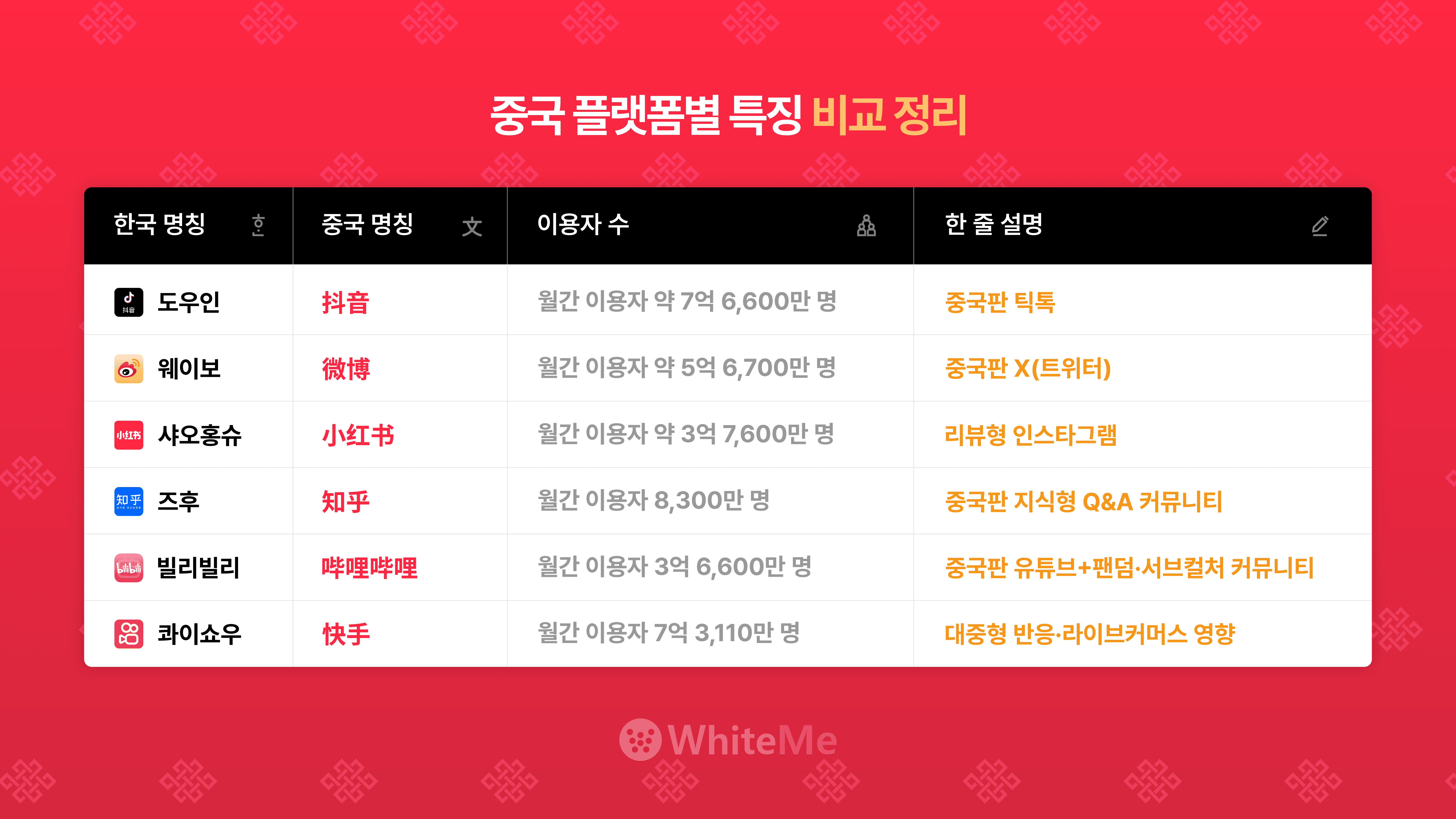
Among them, this tendency appears more clearly among customers in the Greater China region.On platforms such as ‘Xiaohongshu’, actual experiences, photos, videos, and comments are often perceived as more persuasive than advertising information.
This means that even if a brand feels that there is no particular problem, a completely different perception can be formed within the context of the information that local users encounter.
In particular, some negative posts or repeated comments can easily be perceived as larger than the actual scale, but when language and platform characteristics overlap, it is not easy to accurately gauge the impact internally.
The protagonist of this case was Company U, which operates in the medical and beauty fields. Although Company U did not have a separate corporation in China, the influx of Chinese customers visiting Korea was continuing, and its own exposure through Xiaohongshu was already taking place.
In other words, the Greater China region was not simply a market for examining possibilities, but a channel where actual customer contact had already been established. Therefore, beyond simply checking whether there is exposure,There was a need to check together what kind of response was being formed locally.
📌 Case Preview
- Are you just checking customer reviews from Greater China and whether or not the brand is mentioned?
- Can I just pass on the Chinese posts that have started showing up repeatedly?
- The real risk was ‘repeatability’ rather than the number of posts.
- What was needed before responding was a standard for classification.
- Start with Greater China marketing and reputation management first.
Are you just checking customer reviews from Greater China and whether or not the brand is mentioned?

Are you just checking customer reviews from Greater China and whether or not the brand is mentioned?
Hello, Jimin! First, please briefly introduce U and its current operating situation. In particular, please tell us to what extent you have established contact with customers in the Greater China region.
Jimin: Hello, my name is Na Ji-min and I am working as a coordinator at U Clinic, which provides professional skin medical technology to global customers. We had a steady influx of foreign customers.
Although we were not at the stage of establishing a separate base in China, Chinese customers visiting Korea continued to visit the hospital, and information and content related to us were being exposed on channels such as Xiaohongshu. So, internally, we thought that the response from the Greater China region could not be viewed only as a reference level.
In the case of Company U, reputation management was not in the form of a hasty response after a specific issue arose. Since customer contact points in the Greater China region were already being formed, it was necessary to check whether there was a difference between what the hospital was conveying and the perception actually received by local users.
Especially for hospitals and clinics that continue to see an influx of overseas customers, simply increasing exposure is not enough.By examining how customers perceive the hospital and in what context they form trust, future operational decisions will become clearer.
In channels such as Xiaohongshu where reviews and exploration occur simultaneously, there are many cases where the experiences and reactions voluntarily left by users have a greater impact than the information directly managed by hospitals or clinics.
Therefore, monitoring in the Greater China region goes beyond checking for mentions and is closer to reading how actual customer contact points are being formed.
From the perspective of hospitals and clinics, along with expanding exposure,We need to look at what name our brand is searched for and what stories it is connected to and consumed so that future marketing and operations do not diverge.
Can I just pass on the Chinese posts that have started showing up repeatedly?
Can I just pass on the Chinese posts that have started showing up repeatedly?
The influx of Chinese customers was continuing, and content related to lawmakers was already being exposed on Greater China channels. Nevertheless, what made you feel that separate monitoring was necessary, and what were your biggest concerns when you first recognized the problem?
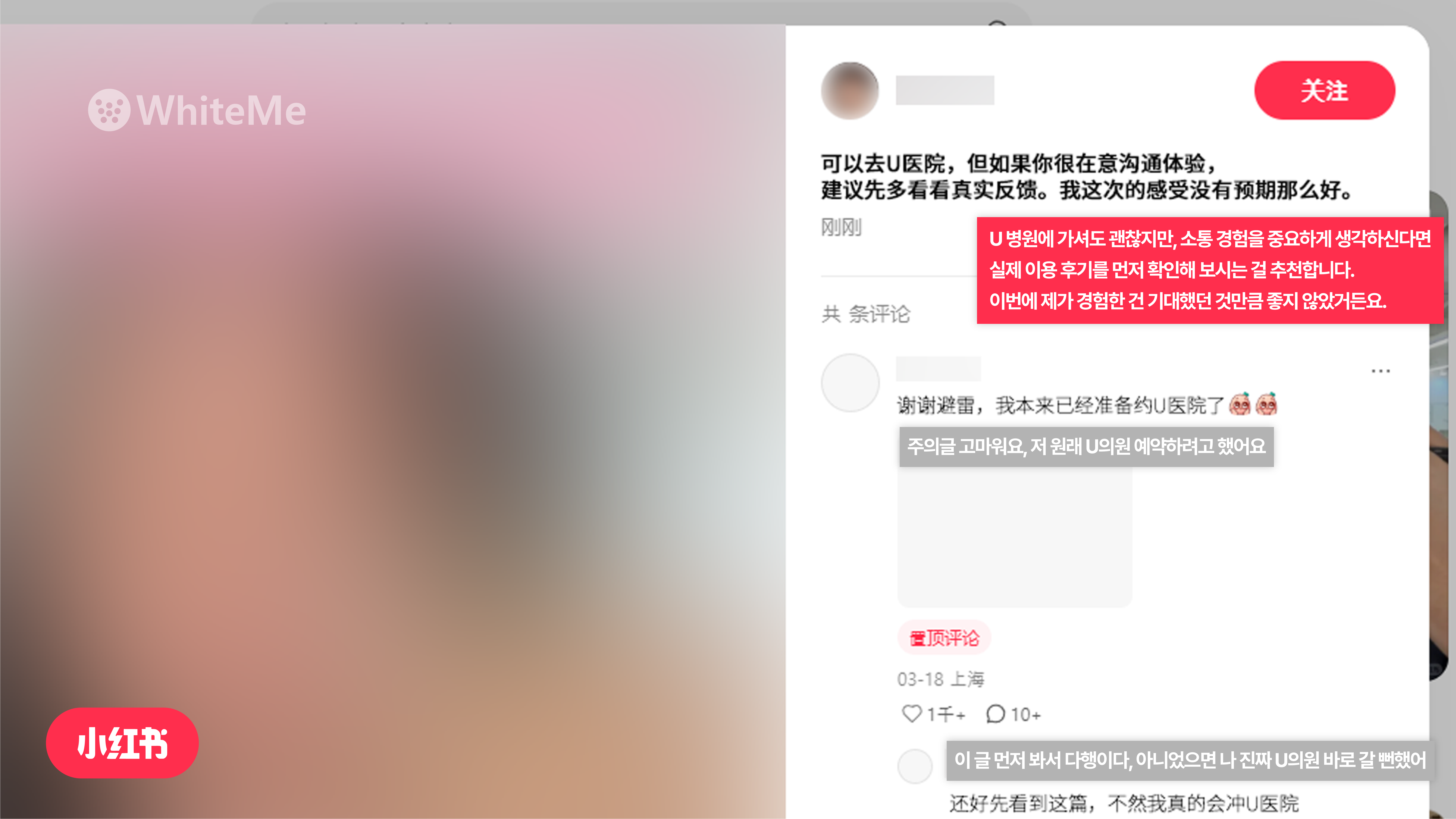
Jimin: At first, I became aware of the problem when I saw a certain Chinese user repeatedly posting negative posts about us in Chinese on Xiaohongshu (小红书). It wasn't just a one-time complaint, similar content kept coming up, and I thought it could lead to other channels as well.
We were also looking into some internally, but it was not easy to determine whether this was a meaningful response from the Greater China region or whether it was a repeat behavior of some accounts. So, I needed to check if I could just pass this by now or if I should look into it in advance.
When hospitals and clinics come across negative comments online, the first things that come to mind are usually similar types of concerns.
Will this issue become bigger? Is it already affecting my reputation? Will it be too late if I don't respond now?The same question naturally follows.
However, in actual work, it is important to first distinguish the size and nature of the problem rather than directly responding to this anxiety.
Because one post that stands out is not representative of the entire public opinion. Conversely, even seemingly small movements can affect perception through repeated exposure within a specific platform.
The situation that Company U faced was not much different from that. It was definitely a concern internally, but it was difficult to be sure how much influence it had externally.
In particular, the fact that it was a Chinese post, and that similar movements were seen in channels such as Xiaohongshu, which are difficult for practitioners to look into on a daily basis.Because of this, I couldn't help but feel bigger.
So, rather than defining this issue first, Company UChecking what type of issue the situation you are currently looking at actually is.has introduced a monitoring service in the Greater China region.
The real risk was ‘repeatability’ rather than the number of posts.
The real risk was ‘repeatability’ rather than the number of posts.
In fact, it seems that the process of receiving the monitoring report and interpreting which reactions are being repeated and how they relate to actual public opinion would have been more important than simply looking at the amount of negative reactions. What was the difference between the internal points you particularly wanted to check and the actual response?
Jimin: There were two things we wanted to know the most. One was to what extent the negative content posted by a specific user actually had influence in the Greater China region, and the other was the overall perception of our congressman, regardless of the person's claims.
I thought that if the overall public opinion had already deteriorated significantly, the response method should be different, and conversely, if the situation was similar to the repetitive behavior of some users, we should look at it differently. In fact, when I checked the data in the report, I found that rather than the overall response in the Greater China region leaning in one direction, it was closer to a structure in which some users' repeated misconduct was more noticeable.
We were also able to confirm that there is a difference between opinions mainly seen in Korea and points that are particularly sensitive in the Greater China region.
What was important at this stage was more than the existence of the post itself.It was a matter of seeing together in what context the post was being consumed.
There are many posts online that contain similar negative content but have completely different meanings. Someone leaving a strong complaint once must be viewed differently from multiple users repeatedly pointing out similar issues.
Also, the tone of the comments, the reactions of other users, and how similar comments are followed often have greater meaning than the body of the post.
Therefore, it is difficult to determine the actual risk simply by counting the number of posts.
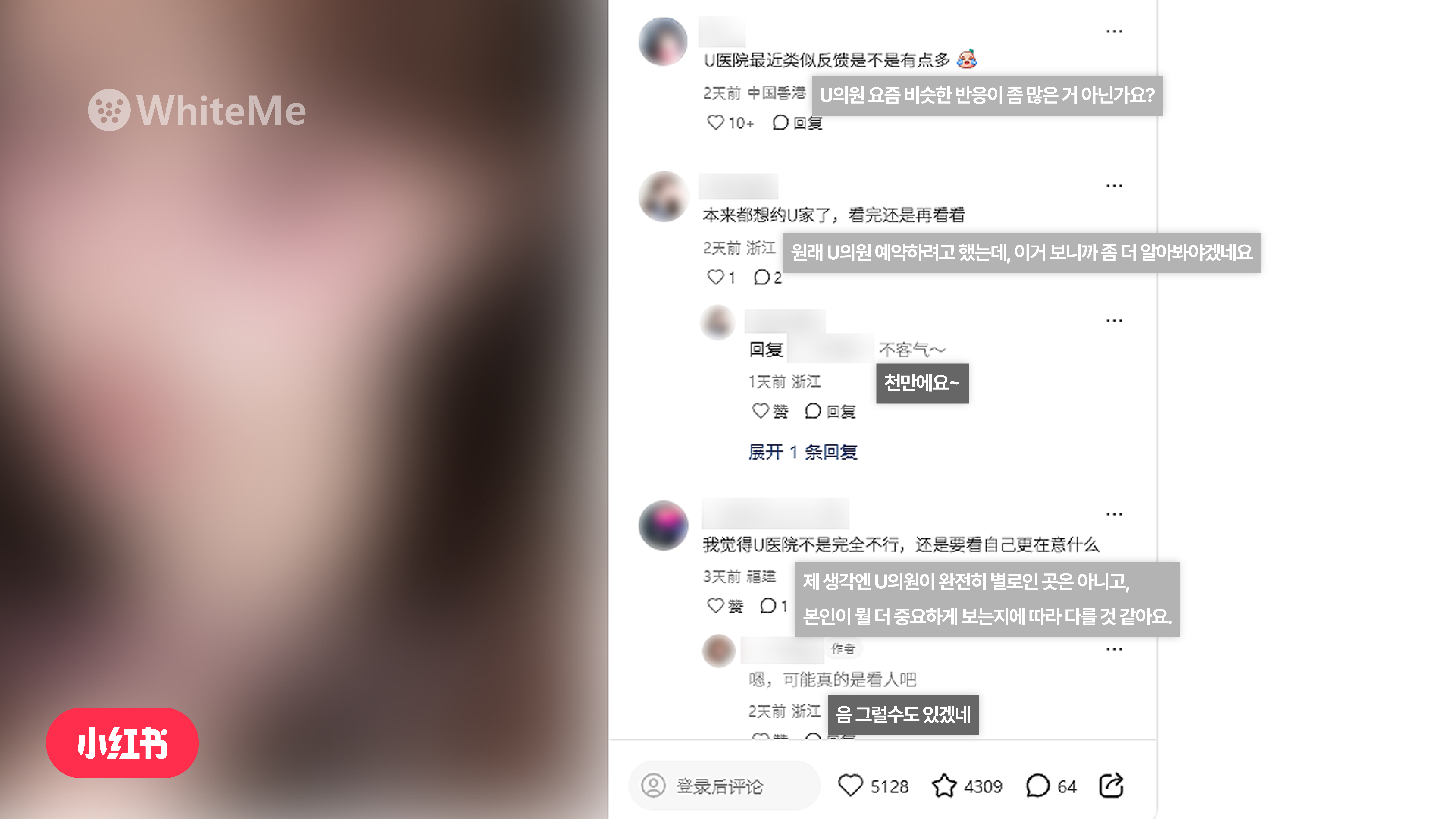
Rep. U also looked at the reactions linked to Xiaohongshu and found that it was difficult to see the overall reaction in the Greater China region as being unilaterally negative.
However, a pattern was clearly confirmed where some specific users repeatedly left expressions dissuading them from using the hospital, reinforcing negative impressions. At the same time, there were differences in the way responses were formed domestically and in Greater China.
In Korea, there were relatively more comments about the overall hospital experience or satisfaction after the procedure, but in the Greater China region, there was a tendency to be more sensitive to issues of experience during the consultation process, explanation method, perception of the person in charge of the actual procedure, and fairness regarding the price.
This clearly revealed that the importance of the same hospital can vary depending on the market.
What was needed before responding was a standard for data classification.

What was needed before responding was a standard for data classification.
In the actual response stage, it would have been necessary to go beyond simply collecting negative posts and organize which messages were being repeated in which channels and how they were distinguished from the overall perception. What was the most important decision in the process?
Jimin: The most important thing was not to view all posts that stood out as the same issue. Because users who appeared to be the same person were repeatedly posting posts and videos on Xiaohongshu and other platforms in the Greater China region, the risk felt much greater.
However, I thought that if the movement was immediately accepted as general public opinion, the response might be excessive. So, by looking at which phrases are repeated, what the mood of the comments is like, and whether other users actually agree with the claim, I tried to divide into problems that need to be responded to right now and problems that need to be decided after watching a little more.
In fact, this is the most difficult situation for many hospitals and clinics when faced with online issues.Even though the fact that there is a post can be confirmed, it is not easy to determine whether it is a problem that needs to be addressed right away or whether it is a problem that needs to be resolved by looking at the flow a little further.
In particular, it is easy to delay understanding the context of overseas channels due to language barriers, and when cultural differences between platforms are added, the internal experience may be more shaken than it actually is. So, in practical terms, we need more data that creates judgment standards than information that increases anxiety.
In this case, we did not just look at simple exposure through monitoring in the Greater China region.It became clear that we needed to look at repeating patterns, the flow of comments, and even the search term connection structure.
You should look at the hospital name, Chinese notation, and search expressions that can actually be used in Xiaohongshu.This is because we were able to more accurately read the flow of local public opinion.
Only through this process can future responses be prevented from being excessive, and the points that actually need to be addressed can be seen more clearly.
Must be able to monitor overseas customers and ‘interpret’ their reactions
So what data was Congressman U actually able to check through this monitoring? Also, what did the experience of introducing monitoring in the Greater China region mean internally?
Jimin: The most meaningful thing was that I was able to see again an issue that had been vaguely unsettling within an actual response structure. We were able to distinguish whether the overall public opinion in the Greater China region was already negative, or whether the repeated postings of some users were making the issue more noticeable.
It was also great to be able to see which expressions were being repeated and which issues needed to be responded to right away and which issues needed to be watched more closely.
What was meaningful in this case was not simply that many fraudulent posts were identified.
Previously, even if a single Chinese post was shown, it could only be felt as a signal reflecting the entire local public opinion, but after monitoring, it was possible to interpret the issue more structurally by looking at the flow of repeated accounts, expressions, and comment responses together.
In other words, it is not about accepting what is seen as is.You can now tell what kind of reaction you are seeing actually is.no see.
This difference is also an important factor for companies or brands considering overseas monitoring. Even if you see repeated mentions of your company in channels in the Greater China region, the way you respond will inevitably vary depending on whether it is an actual risk, repeated behavior by some accounts, or a reaction resulting from differences in perception by market.
In the end, what is needed is a standard for interpreting the current reaction rather than the presence or absence of mention itself.
Start with Greater China marketing and reputation management first.
Start with Greater China marketing and reputation management first.
If you are a company or brand targeting Chinese marketing or the Greater China market,There is a need to regularly check in what context the brand is being consumed within the Greater China channel.
Especially on a platform like Xiaohongshu where reviews, searches, and comment responses work together, you need to look at the context in which something is being mentioned rather than just whether or not it is exposed.
White Me’s Greater China monitoringWe are checking the following areas together.
- Brand exposure status by channel
- Related keywords and repetitive expressions
- Spread of negative posts and comments
- Whether or not a specific author has repeated actions
- Comment reaction and awareness formation flow
- Response priority classification
We structurally examine the context in which our company's name is being consumed in Greater China channels, including Xiaohongshu, and provide support to identify the flow of actual responses and risk priorities rather than simply confirming exposure.
If you have the ability to unravel and interpret this structure, you can more accurately identify risks that should not be missed without overreacting.

In the case of Greater China channels, we see repeated mentions of our brand, but it is often difficult to determine whether it is an actual risk or mere exposure. If you are in a situation where monitoring of China is necessary, please first check within what flow the current response is taking place.White Me helps brands make decisions based on actual market reactions instead of vague fears.
📚Download service introduction
※ This case image was created with AI to protect customers. White Me protects customer information in accordance with NDA.