


Controversy over ‘community-made components’ arose after the launch of a new product
Controversy over ‘community-made components’ arose after the launch of a new product
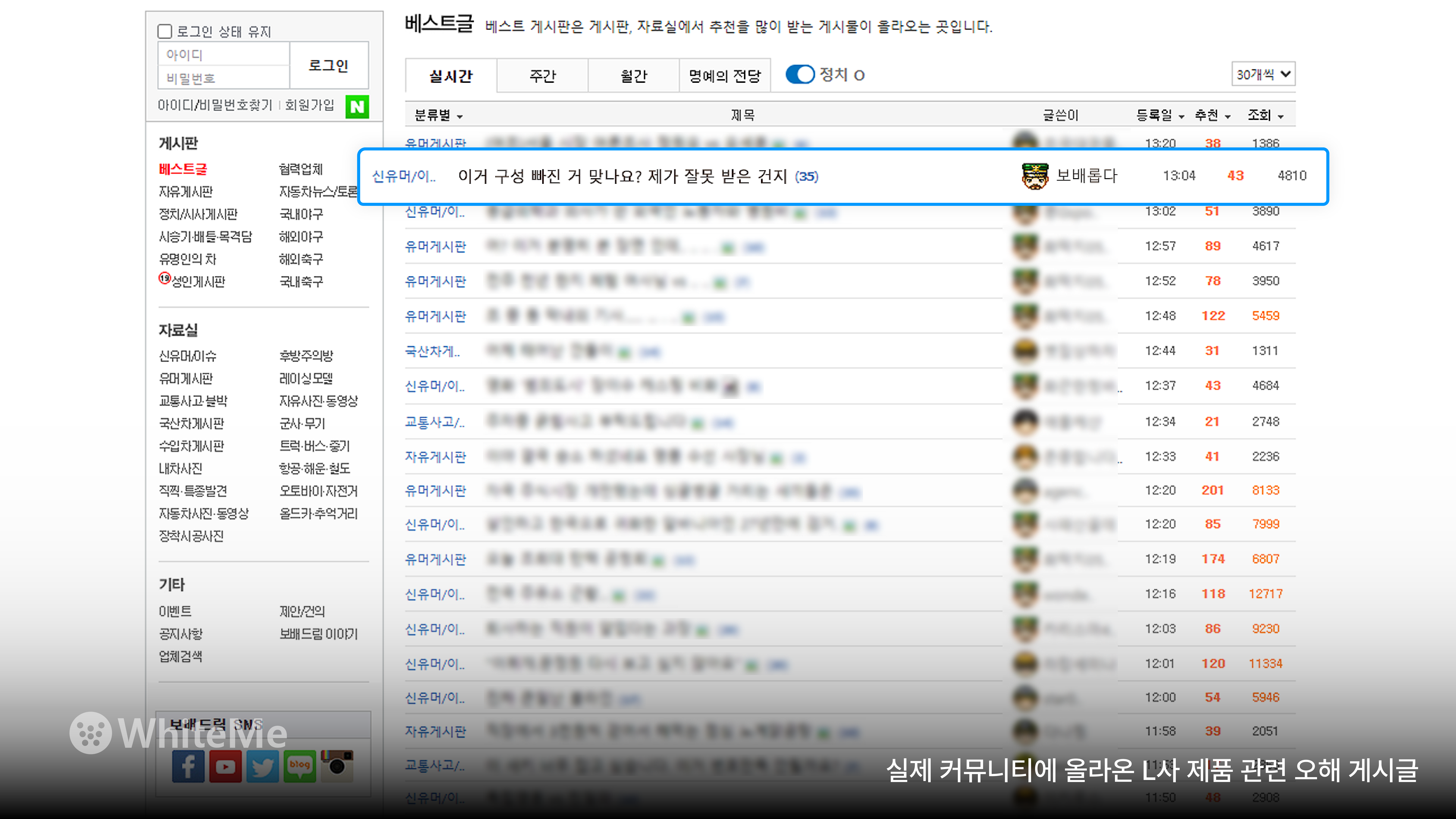
A new product has been released. It was a project that took several months from planning to development and marketing. Expectations must have been high inside. But a few days later, a post like this came up in a community.
“Isn’t this a strange composition?”
The content of the post pointed out that the ‘basic composition’ written on the product label and the actual components were different. In reality, the components were different depending on the options, but the differences were not communicated clearly enough.
At first, it may have seemed like a simple question. However, as comments are made, the atmosphere begins to change little by little. Responses followed, “Isn’t it a labeling issue?” and “Is there a legal problem?” The expression “recall” even appeared in some comments.
The product was not subject to a recall. It was not a confirmed legal violation. Nevertheless, the moment the word ‘recall’ was added, a simple issue of confusion over configuration instructions began to be read as a possible recall issue.
In this way, perceptions move ahead of facts online. When the related search term ‘recall’ begins to appear along with the product name in search results, consumers begin to form an image based on the results. It was a separate issue from whether there was an actual recall or not.
What the consumer goods company L, the protagonist of this case, felt was not the absolute size of the issue.
This was because the timing of when this trend was recognized internally was more important. The fact that the situation was felt only after the spread had already begun, and that time difference became the starting point for this project.
📌 Case Preview
- We are monitoring, but why is the judgment delayed?
- Why simple monitoring was not enough to prevent brand risk
- Why did we check the collection structure rather than the internal operating system?
- As response systems improved, the scale of risk decreased.
- Want to manage brand reputation risk more professionally?
We are monitoring, but why is the judgment delayed?

We are monitoring, but why is the judgment delayed?
Hello, Jeonghoon. Could you briefly explain your current role at Company L and the extent to which you are responsible for brand risk management?
Jeong Hoon: Hello. My name is Jeong-Hoon Lee, and I am in charge of the brand risk management team at Company L. When brand-related issues arise online, our role is to monitor them, determine whether they are real risks, and organize internal response directions. We are looking at the entire flow, including communities, SNS, and articles. Coordinate response with relevant departments as necessary.
While managing the online response after the launch of a new product, there were specific situations where you felt that the existing monitoring system was insufficient. What was the trend at the time, and what did you think was the biggest problem?
Jeong Hoon: It was right after the launch of the new product. A post was posted in one community saying that the basic composition instructions written on the product label and the actual components are different. In reality, it was a structure that varied depending on the option, but I think that part wasn't clear enough. At first, it seemed like a simple inquiry. However, the comment “Isn’t it subject to a recall” began to appear in the comments, and the expression spread to other channels. I was seeing articles and social media notifications, but it was only after the atmosphere had already formed that I felt the situation from within.
This case did not indicate a major quality defect. It wasn't a legal violation, it was more of a confusion in interpretation due to the guidance method.
However, when the expression ‘recall’ appeared in the comments, perceptions changed. A post that raised issues about configuration guidance began to be treated as if the possibility of a recall had been discussed. As the expression was also displayed in search results, the nature of the issue began to look different.
What Company L was worried about was not “Is this actually a big problem?” but “When did we know about this?” The fact that it was felt only after the spread had already begun led to the decision that the structure needed to be redesigned.
Why simple monitoring was not enough to prevent brand risk

Why simple monitoring was not enough to prevent brand risk
When you re-analyzed the situation at the time, you saw that there were limitations in the operating structure itself rather than simply a lack of channels. What part did you think was delaying your judgment?
Jeong Hoon: It’s not that the channel itself didn’t exist. I was watching the community, receiving social media notifications, and separately monitoring articles. However, I could not see it as a single flow. Then, the word ‘recall’ appeared in the comments and the search volume started to rise little by little, and only then did I see the full picture. It wasn't that I wasn't looking at the data, but it was just that they weren't connected to each other.
On the surface, monitoring was taking place. However, ‘collection’ and ‘judgment’ were completely different issues.
If community posts, comment reactions, emergence of risky expressions, spread on SNS, and changes in search volume do not appear as a single flow, internal judgment will naturally be delayed. In particular, expressions that directly stimulate consumer anxiety, such as ‘recall’, first affect perception regardless of whether they are true or not.
The limitations faced by Company L were not due to a lack of channels. There was no structure in place to read data as a flow.
Corporate reputation management is not about securing a lot of data;Establishing a system to distinguish which signals have the potential to turn into actual risks at an early stageIt is said that you have come to feel that it is closer to .
Why did we check the collection structure rather than the internal operating system?
Why did we check the collection structure rather than the internal operating system?
After deciding to redesign the structure, you said you looked at both internal development and external solutions. I'm curious about what criteria you used to make the final decision during the process.
Jeong Hoon: The most important thing was security. It was difficult to choose a structure for outsourcing brand-related data. It was also important to be notified immediately when a danger signal appeared and to be able to share it internally.
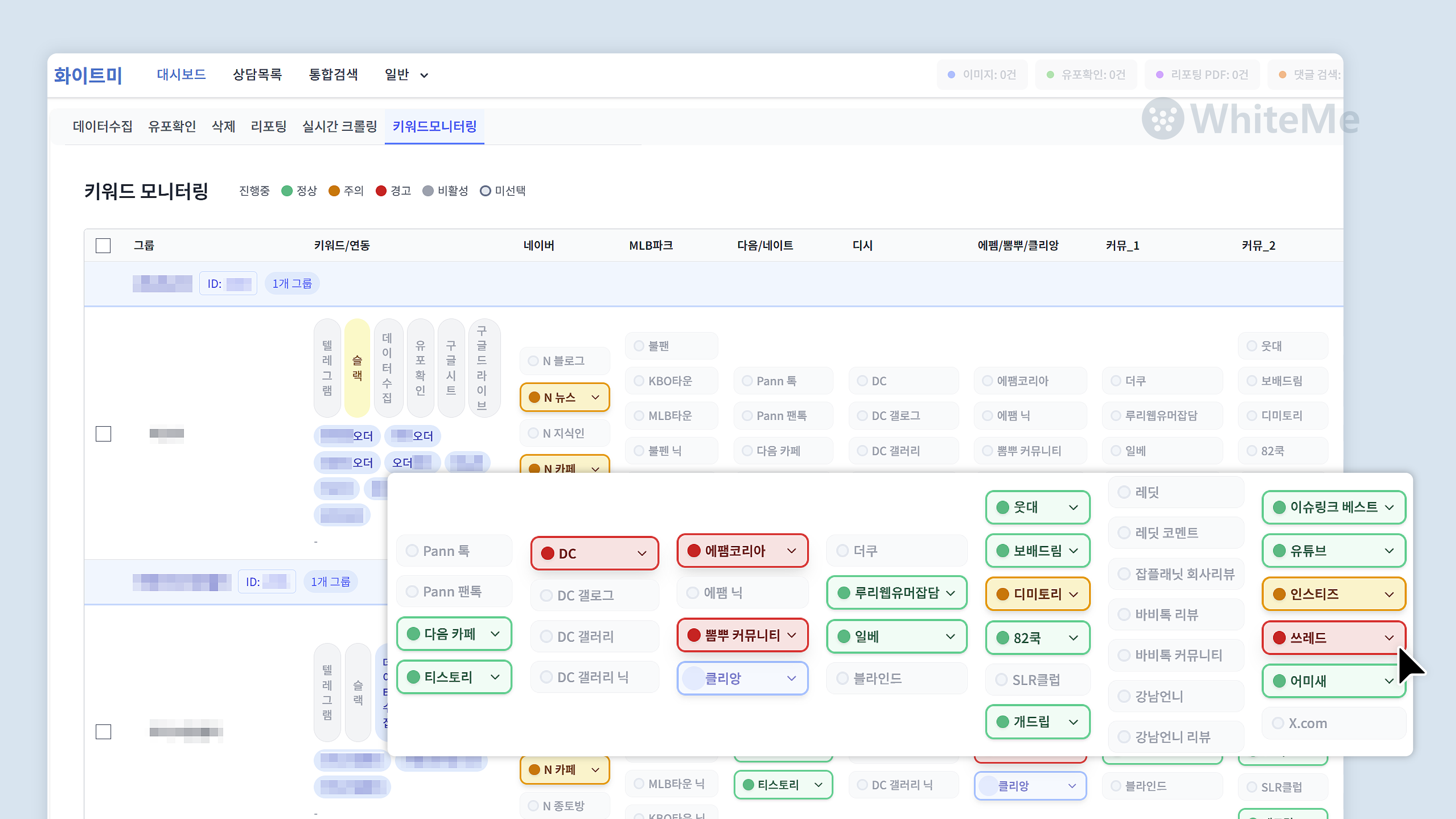
White Me designed its structure to suit L Company’s special internal environment. We grouped scattered data into one flow and reorganized brand-specific keywords.
We established risk detection standards focusing on expressions with a high probability of spread, such as ‘recall’, ‘display issue’, and ‘missing configuration’.
Why was it external collaboration rather than internal development?
Here's a question that naturally arises:
If there was a team that specialized in managing brand risk, internal development could have been fully considered, but why did Company L choose external collaboration?
In fact, Company L also reviewed internal development plans. This is because the option of building the system yourself was a realistic alternative. However, one thing became clear during the review process. The problem was that community-based data was more complex than expected.
The collection structure of online platforms changes more than we think, with new words and circumstantial expressions constantly changing, and as the UI/UX of major communities and SNS change regularly, situations in which collection logic needs to be constantly modified are repeated.
Therefore, we can see that maintenance and management are more important areas rather than a structure that ends with creating a program once.
Likewise, for Company L, continuing to update and operate stably seemed to be a bigger challenge than initial design, and at this point, domain understanding and operational experience served as important criteria for external collaboration.
As response systems improved, the scale of risk decreased.

As response systems improved, the scale of risk decreased.
What was the first change you noticed in actual operations after the structural transition? Can you also tell us how the judgment speed and response method have changed compared to the previous system?
Jeong Hoon: What struck me the most was timing. In the past, it only took action internally after it spread to social media and the search volume increased, but now notifications are sent at an early stage when dangerous expressions appear. Therefore, we were able to quickly determine the level of risk and proceed with fact-checking and guidance supplementation without overreacting.
Before the structural transition, our operations were relatively simple. He said that when the number of negative comments exceeded a certain level, a meeting was held and discussions continued on whether “this is really a crisis.”
However, because the judgment criteria were not clearly organized, there were cases where the response was excessive, and conversely, there were also cases where the approach was overly conservative.
In the end, you said that the focus of the discussion was repeatedly focused on ‘how to interpret whether there is a crisis’ rather than the essence of the issue.
Jeong Hoon said that in the approach after redesigning the monitoring and customer reaction confirmation structure, a system was established to classify risks by looking at sentiment analysis, the direction of comments, and the spread channel together, making it possible to make a first judgment on whether it was a simple complaint or a possibility of structural spread.
This change made it possible to focus internally on issues with a high likelihood of spreading rather than reacting to all issues with the same intensity, and meeting times were naturally reduced. The speed of decision-making also began to move in a different direction than before.
Ultimately, corporate reputation management is not about completely eliminating crises;It can be seen as closer to establishing a system for classifying and responding to certain issues and by what criteria.
Want to manage brand reputation risk more professionally?
Want to manage brand reputation risk more professionally?
The case of Company L does not apply only to specific companies. In any industry where online consumer response affects sales and brand trust, similar structures can be repeated regardless of size.
Even if you are monitoring articles and providing SNS notifications, if the data is not structurally connected, judgment can naturally be delayed.
In the end, what is important is not ‘whether it is being operated,’ but ‘what structure is it operating under.’Check our brand’s risk management process through the brand monitoring system self-check list below!
Operating system self-check list
- This is a method where the person in charge directly searches and confirms community posts.
- There is no management system to separately track risky keywords.
- It is a structure that does not monitor multiple platform data together in one place.
- This is a method of judging risk by only looking at the amount of mentions without sentiment analysis.
- Internal notification is not an automatic system, but relies on confirmation by the person in charge.
- Issue response standards and procedures are not clearly organized.
If any of the above items apply, we recommend that you check our company's brand monitoring operation structure right now.

It is realistically difficult to completely block brand risk. However, it is possible to design structures that can detect faster and judge with clearer criteria.
Check whether the currently operating corporate reputation management system is keeping up with the actual rate of risk spread. White Me will work with you to design a response structure suited to your company’s environment.
👉Inquire about introducing the White Me service
📚Download service introduction
※ This case image was created with AI to protect customers. White Me protects customer information in accordance with NDA.