


Fraudulent posts, verification alone may not be enough
Fraudulent product-related posts are not only visible on one channel. It is left in search results, posted on social media, and spread through community posts and comments.
From a company's perspective, it is not easy to keep track of where and what posts are being posted.
However, in practice, what is more difficult is after discovering the post. This is because you need to organize which posts to respond to first, which posts to consider and even request for deletion, and what to do with the follow-up response.
Although it is possible to confirm that a post has been posted through simple monitoring,Cases that do not immediately lead to actual actionThere are a lot.
Company C, the customer in this case, was in a similar situation. Negative posts related to our products were appearing repeatedly on some channels.We needed a way to quickly check these posts without missing them, as well as request deletion of posts that actually needed action.
What Company C was looking for was not a monitoring tool that simply collects and displays posts. It was closer to an operational structure where discovered fraudulent posts could be requested to be deleted and followed up with follow-up response.
📌 Case Preview
- Should we just monitor negative posts about our brand and be done with it?
- Monitoring → Delete request, brand reputation management completed in one queue
- Posts that require follow-up can be sorted out more quickly
- If monitoring alone is not enough, you should also look at ‘delete linkage’
- Contact us for service
Should we just monitor negative posts about our brand and be done with it?

Should we just monitor negative posts about our brand and be done with it?
When first considering a monitoring service, it seems that a structure that can identify problematic posts or comments more quickly and connect with subsequent responses was more important than a general monitoring function. What was the problem you saw as needing to be solved first at the time?
Hyunseong: What we needed was not the function itself to view the amount of mentions. It was important to check without missing a product-related issue when it came up, but in reality, I thought what happened afterwards was more important.
When a negative post or malicious comment is identified, it takes time to internally search, make a decision, and organize a response, so we needed a way to make the process go a little faster.
many companiesWhen a brand reputation issue is recognized, it is after the post has already been posted.There are a lot.
However, in practice, what is more burdensome is the process of deciding how to interpret the post and what priority to respond to, rather than the existence of the post itself.
For example, some posts may only be temporary expressions of dissatisfaction, while others may have a greater impact as they appear repeatedly in search results or recommended areas.
In some cases, this may require a request for removal of the post or even legal review.
If you don't quickly tell the difference, it's easy to miss which posts you should address first, or you may end up responding to all posts with similar intensity.
This was what Company C considered important from the beginning. Rather than simply collecting a lot of posts,In fact, problematic posts should be identified quickly and subsequent action should be taken.I did it.
Monitoring → Delete request, brand reputation management completed in one queue
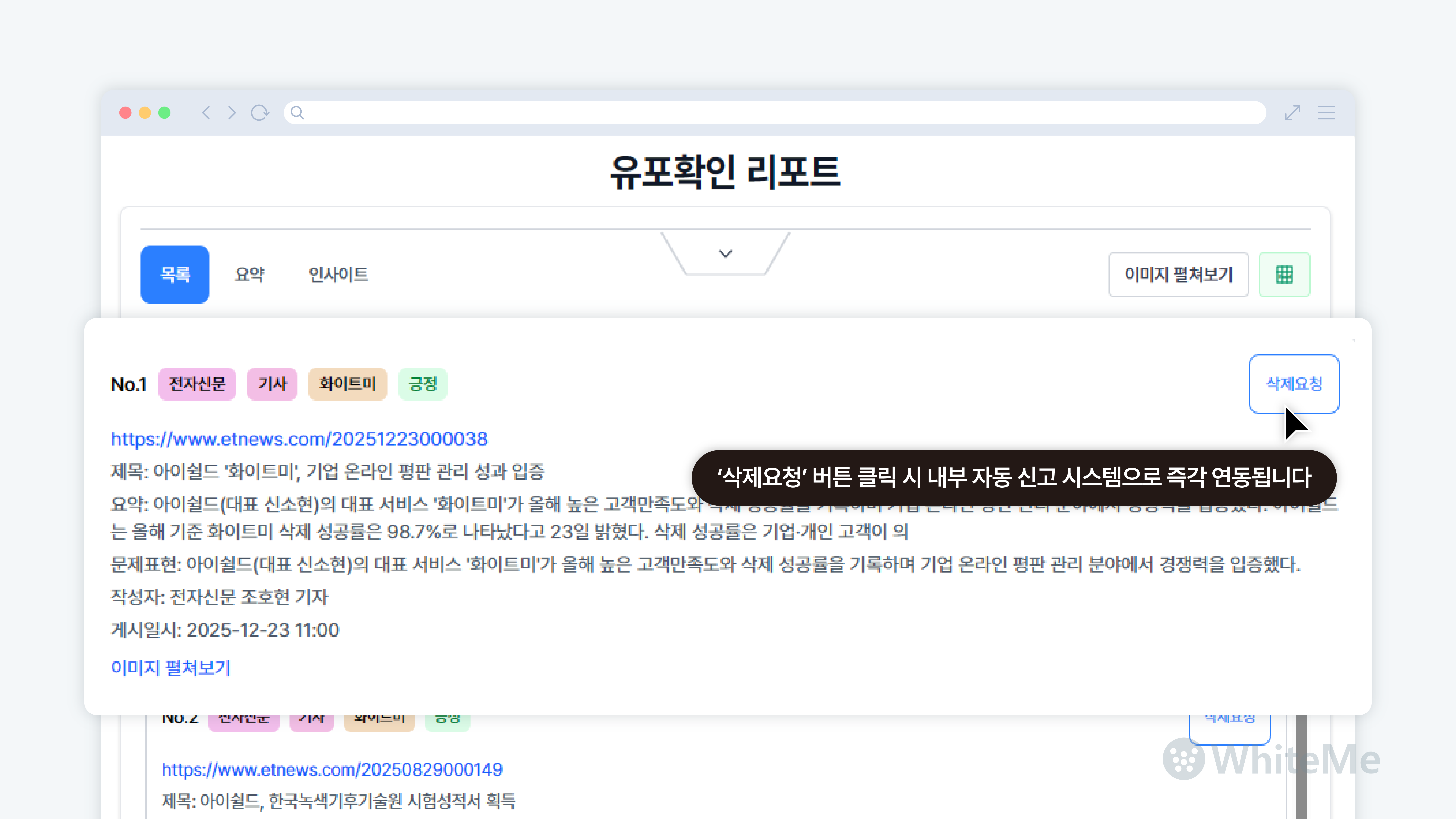
Monitoring → Delete request, brand reputation management completed in one queue
Crawling monitoring data → Real-time monitoring notification → Providing periodic reports → Request for deletion → Automatic reporting system
In the process of specifying the operation method, you may have divided the areas into areas that need to be managed on a regular basis and areas that need to be responded to when actual issues arise. How did you organize the standards for real-time monitoring and notifications, regular reporting, post deletion, and follow-up actions?
Hyunseong: We were distinguishing between those that needed to be monitored on a regular basis and those that could be responded to immediately when an incident occurred. Real-time monitoring and notifications were fundamentally necessary, and I also wanted to see the flow through regular reports.
On the other hand, we decided that it would be more realistic for deletion and follow-up actions to be handled quickly when an actual issue arises, rather than being a regular task. In the end, I think the important thing is not to see a lot, but to have a system that allows you to move immediately when needed.
In reality, brand reputation and marketing-related practices are often divided into two major branches. One is to monitor the flow of comments on a regular basis to detect abnormalities, and the other is to take actual responses when problematic posts or comments occur.
Company C divided these two areas relatively clearly. It was believed that it would be more realistic for a professional company to continuously monitor contact points where actual posts are posted, such as Instagram, Thread, YouTube, and portal-based channels, and to quickly initiate deletion requests or follow-up responses when problematic posts are discovered.
This structure was easy to operate in terms of cost and manpower, and was also suitable for dividing priorities into which posts should be responded to first.
We also took into account the fact that posts that need to be processed urgently can be missed using only monthly reports, and conversely, it is difficult to interpret the flow of posts that accumulate repeatedly using only real-time notifications.
Therefore, White Me proposed a structure that delivers collected posts as regular reports and a method that can link real-time notifications to Telegram, Slack, Google Sheets, etc. as needed.
Thanks to this, Company C was able to quickly check posts that needed to be responded to urgently and identify issues that came up repeatedly as patterns within regular insights.
Here, a linkage method after monitoring was also implemented. Rather than simply reporting the collected posts, we made it possible to immediately review requests for post deletion or follow-up actions according to agreed upon standards.
Simply receiving a list of posts and being able to move on to the actual response stage are bound to have quite different operational experiences.
Posts that require follow-up can be sorted out more quickly

Posts that require follow-up can be sorted out more quickly
It seems that there have been changes in the actual operation method after its introduction. At a slightly different level than simply broadening the scope of monitoring, the standards for which posts to check first and which to respond immediately seem to have become clearer. What did you feel was the biggest change while operating the operation?
Hyunseong: What I felt the most was that the flow was organized. Previously, there was a strong feeling of checking posts by channel and judging them individually, but after the introduction, it became a little clearer which posts should be viewed first, which should be responded to immediately, and which should be viewed as a flow.
Posts that need to be checked in real time can be viewed quickly as notifications, and types that come up repeatedly can be viewed together in regular reports, making it much easier to operate.
In particular, what was most noticeable in practice was that we were able to select and connect to posts requiring deletion more quickly than before.
- Distribution of issue generation channels
- Difficulty in organizing response priorities after discovering fraudulent posts
- Non-separation of real-time check targets and regular flow check targets
- Unclear structure of deletion request and follow-up action after monitoring
- Constructing a real-time monitoring system centered on major channels
- Notification linkage that can be checked immediately upon occurrence
- Organizing issue flow and repetitive patterns through regular reports
- Data preservation and response ranking consulting (risk analysis)
- Request for post deletion and follow-up response when necessary
The first thing that changed after that was the operational flow. Company C was able to first check posts occurring on major channels through real-time notifications, and at the same time see what types of posts were being posted repeatedly and what issues were accumulating through regular reports.
Previously, confirmation by channel and individual judgment were scattered, but nowIt's much easier to tell which posts should be considered for immediate response and which should be managed at a flow level.
The meaningful change wasn't just that we were aware of problematic posts more quickly. This is because the practical burden has become much clearer as it has become possible to distinguish between posts that require a request for deletion and posts that need to be viewed on a regular basis.
Managers no longer have to respond with the same intensity to all posts, and posts they can't afford to miss can be caught more quickly. The flow within the organization has become clearer.
While maintaining internal judgment standards, detecting actual posts and organizing data,As the execution process leading up to deletion linkage has been organized, response speed and consistency have increased.
On the surface, it may seem like a simple case of introducing monitoring. However, in reality, the method of finding a problematic post, requesting the post to be deleted, and taking follow-up actions was closer to being organized one step further.
If monitoring alone is not enough, you should also look at ‘delete linkage’.
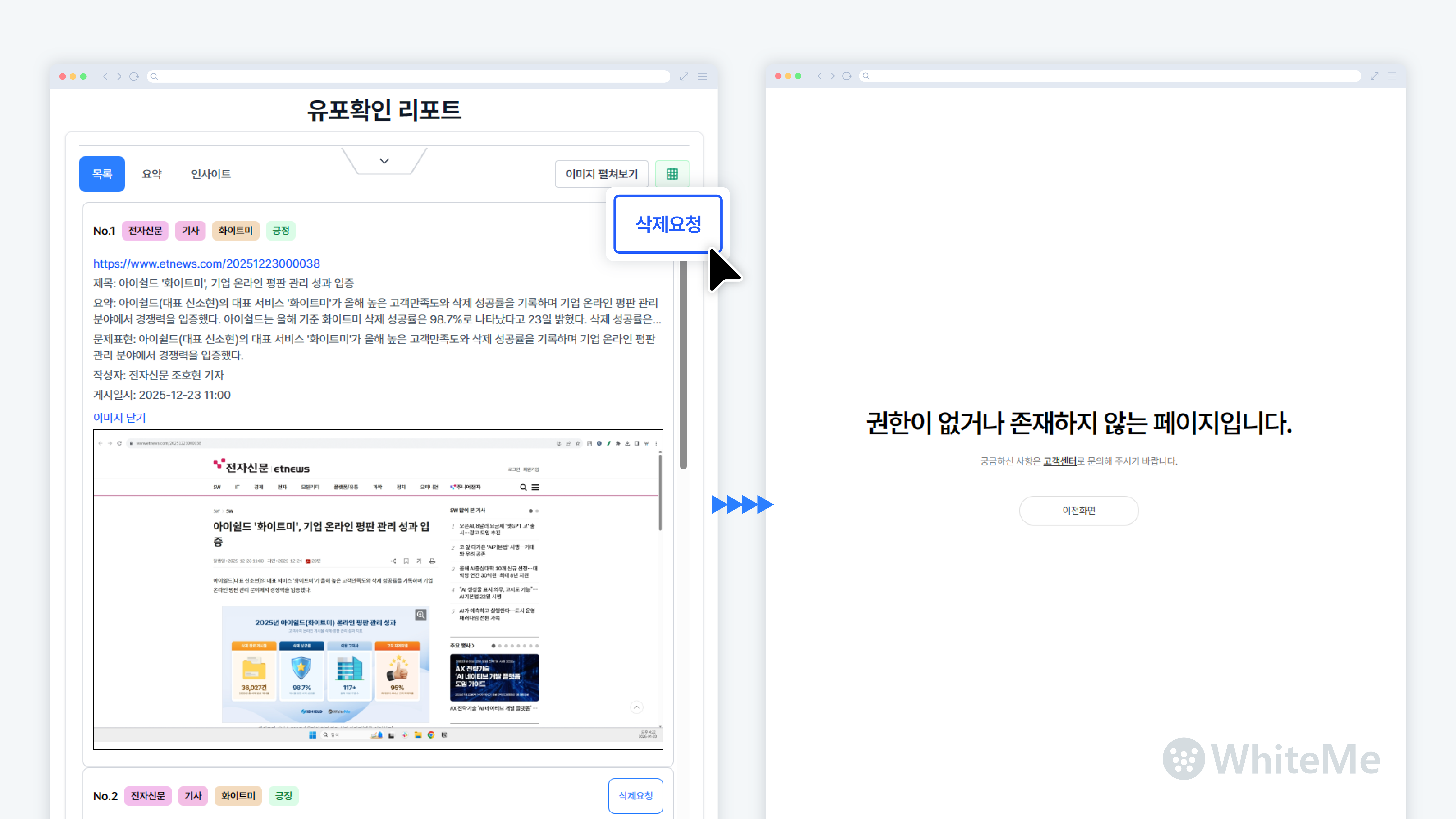
If monitoring alone is not enough, you should also look at ‘delete linkage’
- Are negative mentions scattered across multiple channels?
- Are there a mix of real-time response issues and regular inspection issues?
- Are responses organized separately internally after monitoring?
- Are negative posts affecting your brand perception?
Just checking for fraudulent posts may not be enough.
In particular, if an issue occurs repeatedly across multiple channels, a structure that goes beyond simple confirmation and takes actual action is needed.This will help you avoid missing important brand reputation risk issues and manage the impact on your brand more reliably.
White Me quickly catches issues through real-time monitoring andIf necessary, posts can be linked to a deletion service so that notifications, organizing, deletion requests, and follow-up responses can all be carried out in one flow.We support you.
Now, don't just stop at discovering fraudulent posts, but check the operational structure that leads to actual response.

across multiple channelsResponding to repetitive negative postsIf you are concerned about this, please take a closer look at the current operation method with White Me.
📚Check the service introduction
✉️Email inquiry:support@whitemekorea.net
※ This case image was created with AI to protect customers. White Me protects customer information in accordance with NDA.